Beyond the Chatbot. Agentic AI in Insurance Brokerage.

A brokerage conversation that started with the work
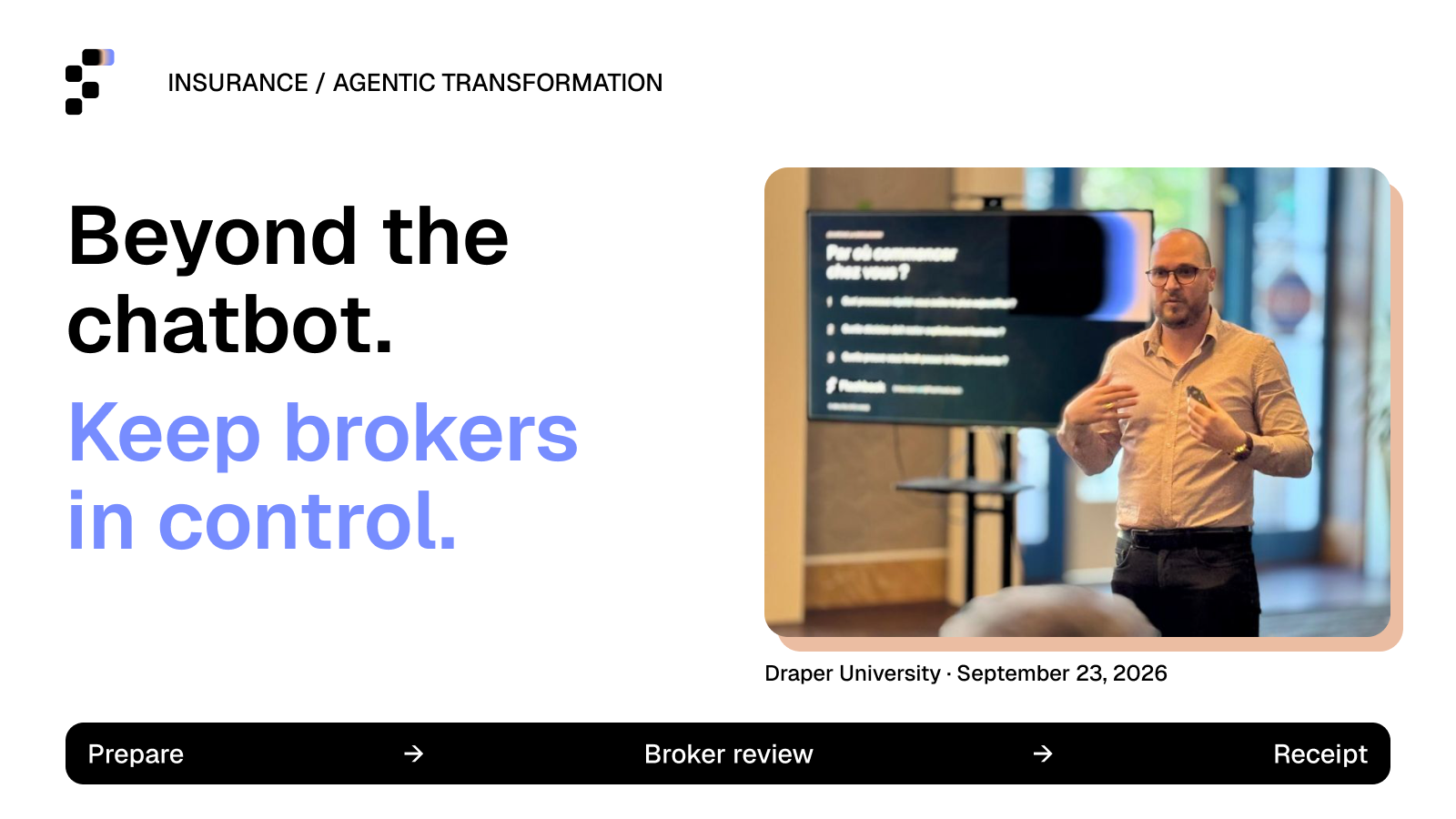
On September 23, 2026, I joined the Planète CSCA delegation at Draper University to discuss agentic AI and Flashback’s approach to transformation. The most useful starting point was the work itself: information entered repeatedly across systems, documents collected from several sources, and the effort required to move a file from preparation to a decision.
The preparation and exchanges brought several priorities into focus: connections between broker and insurer systems, data security, team adoption, and evidence that an experiment can improve everyday operations. These are qualitative lessons from one encounter. They point to a useful question for brokerage leaders: how can AI participate in the work while keeping the responsibility for each decision clear?
A capable conversational assistant can help a broker find information. The larger operating question is what happens after that information has been found. Who checks it? Who updates the file? Who approves its use? Who is accountable when the process reaches an exception?
From an answer to a bounded responsibility
Thinking of AI as a collaborator is useful when it leads to a precise assignment: permitted inputs, defined tools, a clear output, and an escalation path. It does not transfer professional accountability to a model.
There is also no need to make every step autonomous. Anthropic’s architectural guidance distinguishes predetermined workflows from agents that select their own steps and tools. It recommends starting with the simplest design that meets the task. For brokerage operations, that suggests combining deterministic checks with model-assisted interpretation where flexibility is actually useful.
For example, a required-field check can remain ordinary software. Extracting a candidate renewal date from an inconsistent document may benefit from a model, provided the result is linked to its source and checked before use. Choosing the commercial recommendation remains a separate responsibility.
This distinction also helps decide where to start. A useful first workflow repeats often enough to evaluate, has accessible source documents, produces a recognizable output, and gives staff a practical way to correct mistakes. Renewal preparation can fit that pattern. An unresolved coverage dispute requires a different level of professional judgment. The right degree of delegation depends on the task and the consequence of an error.
A renewal workflow worth testing
During the presentation, I used renewal preparation as an illustrative design. It is a proposal to build and evaluate, not a deployed Flashback insurance solution or a customer result.
| Stage | Proposed agent contribution | Retained human or system control |
|---|---|---|
| Gather | Retrieve permitted client and policy material | Enforce case-level access and record provenance |
| Check | Identify missing documents and conflicting fields | Validate required fields; escalate uncertainty |
| Prepare | Assemble a structured renewal file and supporting references | Keep extracted facts distinct from inferred suggestions |
| Review | Present the file, changes and unresolved questions | Broker validates the material and approves the next action |
| Submit | Transmit an approved version through an authorized interface | Enforce the approved scope and retain a receipt |
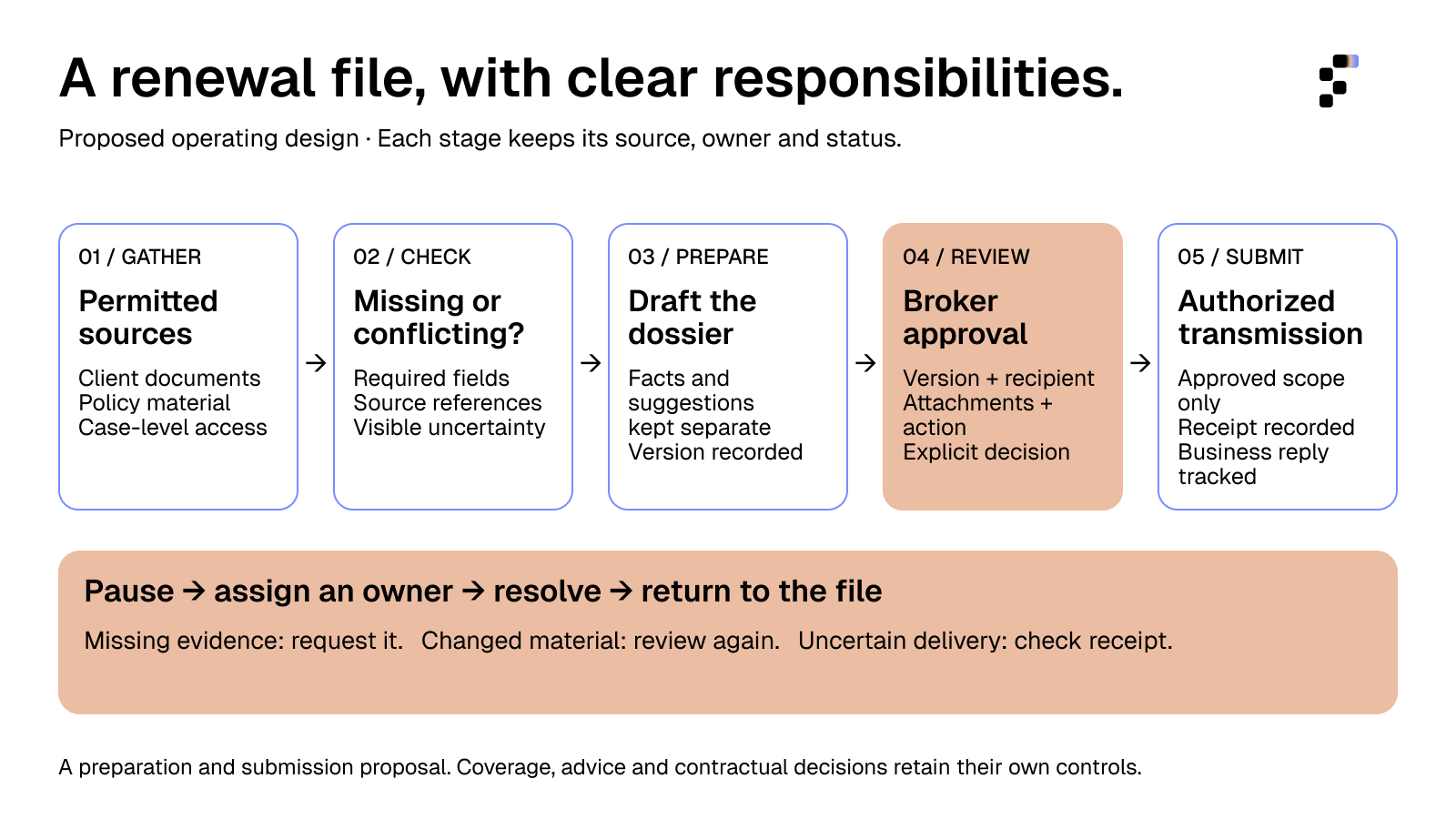
Consider a file where last year’s policy and a recent client document show different addresses, while one required attachment is missing. The useful output is a draft that exposes both addresses, identifies their sources and dates, and lists the missing item. The agent should leave the conflict visible for resolution. Silently choosing the newest-looking value would conceal a business decision inside document processing.
An exception needs more than a warning icon. Give it a reason, an assigned owner, a due date and a next step. The broker can resolve the discrepancy or request clarification, then return the corrected material to the same file. This keeps the case moving without treating uncertainty as permission to guess.
This sequence changes the unit of design. Instead of asking which screen needs a chatbot, the team asks what is required to produce an accepted, traceable file.
Make approval a specific business decision
“Human approval” is meaningful only if the reviewer can see what they are authorizing. In this proposed design, the review screen should show the file version, intended recipient, attachments, changed fields, supporting sources and unresolved questions. It should also state the action: saving an internal draft and sending a dossier to an insurer carry different consequences.
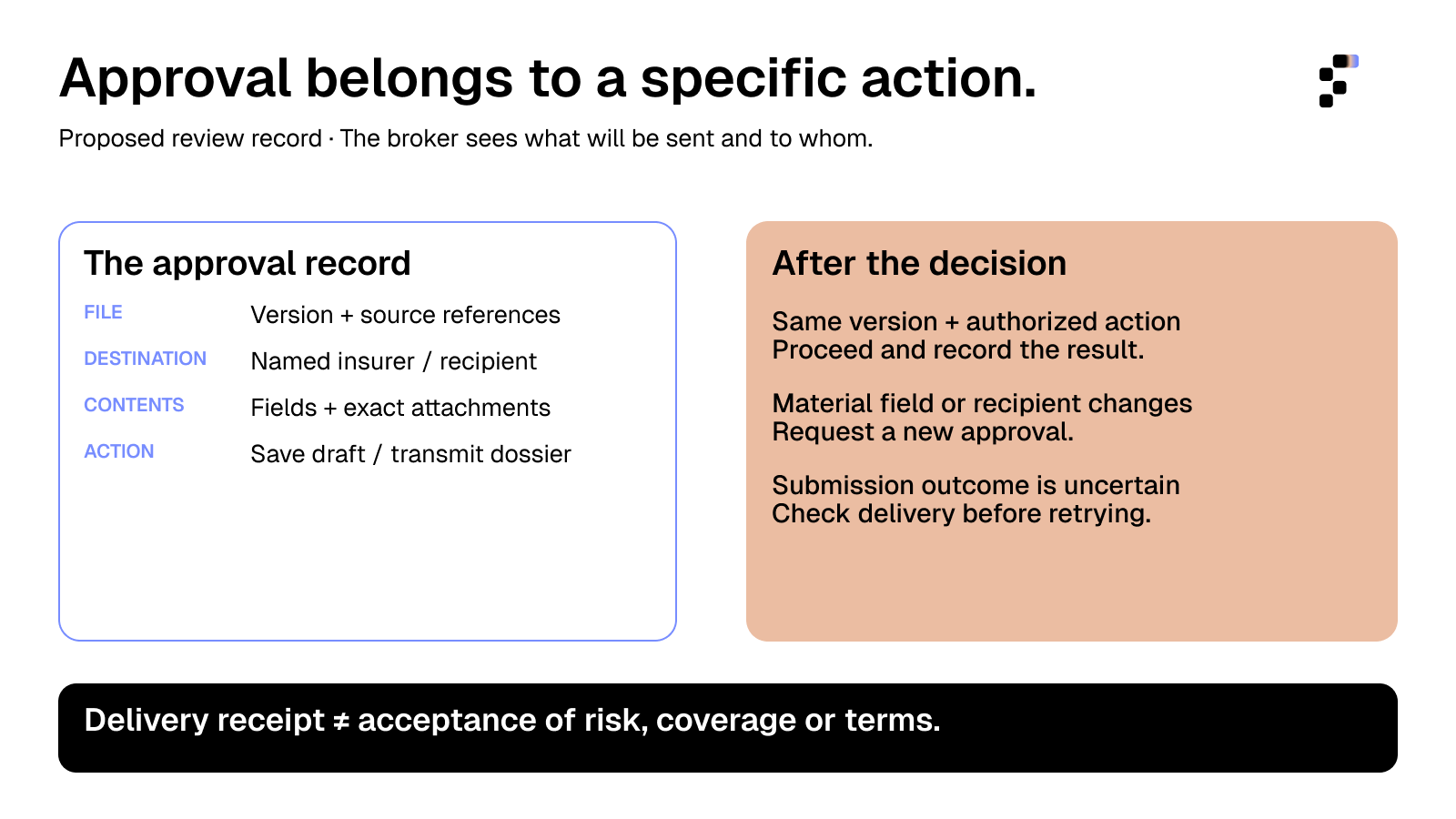
The approval must refer to that particular version and action. If a material field or recipient changes afterward, the system should request a fresh decision. Approval to prepare or transmit a file does not authorize a recommendation, a contractual commitment or a coverage decision. Those responsibilities need their own explicit boundaries.
If a submission times out, first check whether the insurer received it. Where the interface supports duplicate prevention, use a stable submission identifier. Where it does not, an uncertain outcome should go to an operator before another transmission. Record the delivery receipt separately from any later business response. Recovery may require a correction or withdrawal through the insurer’s process; sending information externally cannot always be undone.
Integration is where the operating model becomes real
An agent needs access to systems, but access should not be an unrestricted credential shared across tasks. Our recommended design separates reading a document, editing a draft, and submitting information externally into different permissions.
The Model Context Protocol tools specification provides a useful reference for typed tool interfaces. Its June 18, 2025 revision describes input validation, access controls, confirmations for sensitive operations and tool-use logging. A protocol can structure integration; it does not establish an insurer’s permission, supply a missing connector, or make a deployment compliant by itself.
For a brokerage proof of concept, we would start with a narrow set of allowed actions. Source documents should be treated as business data, not instructions that can change the agent’s permissions. Credentials should remain outside model-visible text. Logs should connect the source material, proposed change, approval and execution result while limiting unnecessary retention of personal information.
Those are proposed engineering controls to test in the actual environment. Security and operational owners need to establish the appropriate boundaries for their systems and data.
The insurer interface is also a design constraint. An authorized API, a document exchange and a browser-operated extranet have different failure modes. Confirm which access method is permitted, what it can acknowledge, and who maintains it. A changed form, an expired session or an unavailable connector should leave the file in a visible state with a manual continuation path. The first useful release may stop at an exportable dossier that a broker submits through the existing process.
Use only the case material needed for the assigned task. The operating design should specify where documents and model requests are processed, who can access them, how long they are retained and how access is revoked. These are choices to resolve with the brokerage’s security and operational owners before connecting live files.
Measure the whole file, including the exceptions
The objective is useful capacity: more attention available for client advice, fewer avoidable handoffs, and less effort spent repairing preventable mistakes. Those are goals to measure, not benefits to announce before a baseline exists.
A practical evaluation needs a defined finish line. For preparation, it could be a broker-accepted dossier ready for submission. If the scope includes delivery, add a verified receipt. Neither milestone means the insurer has accepted the risk or agreed to the terms.
| Measure | What to record | What it helps reveal |
|---|---|---|
| End-to-end time | From case opening to the agreed finish line, including waiting | Whether work moves faster across the whole process |
| Review and rework | Staff time checking, correcting and chasing information | Whether automation shifts effort onto the reviewer |
| Quality and exceptions | Missing fields, unsupported values, conflicts and failed transmissions | Where the process needs better controls or narrower scope |
| Full operating cost | Model usage, integration, maintenance, oversight and rework | Whether the process is useful at its actual volume |
Compare files of similar complexity and report exceptions alongside completed cases. Removing abandoned or difficult files from the results can make an unreliable process look efficient. Set the baseline, acceptable error conditions and stopping rules before the trial. Treat released capacity and cash savings separately: time saved creates an opportunity to improve service, but staffing costs do not automatically fall.
Test difficult cases as deliberately as ordinary ones: conflicting dates, missing attachments, duplicate files, an unavailable insurer interface, and a request outside the agent’s authority. Start with draft-only output, inspect failure patterns, and expand execution rights only when the evidence supports doing so.
The NIST AI Risk Management Framework offers a voluntary reference for organizing AI risk management. It is a useful input to this work, not a certification of the proposed renewal process.
What changes for the team
Agentic transformation is also an organizational decision. Someone must own the workflow, define acceptable output, review exceptions and decide when a change is ready to operate. Brokers and operational staff need a way to correct the system and see what it has done. Involve them in choosing representative files and designing the review screen: a technically valid dossier still has to be useful to the person making the decision.
The opportunity is to reconsider how capacity is allocated before adding more manual steps or expanding a team. That does not establish that recruitment becomes unnecessary. Staffing decisions depend on demand, service expectations, risk and the work people will continue to own.
At Flashback, our approach is to discover and redesign the process, build and integrate it, govern and control its operation, then operate and improve it, with governance throughout. For this insurance example, that means defining one recurring workflow, its owner, the decisions people retain and the evidence needed to extend its scope. A useful next step is a short workflow brief covering those four points before selecting the model or building the interface.
Continue the conversation
Thank you to the Planète CSCA delegation, the RealChange and Draper University teams, and Thierry Gouby for the encounter and the resources shared afterward.
For the journalistic perspective, read Thierry Gouby’s article for News Assurances Pro — French-language article; subscription required — and watch the video shared by Thierry. The operating proposals above are Flashback’s independent analysis. Thierry’s reporting offers a separate perspective on the delegation’s visit.
You can also revisit my original reflection on the meeting. To explore the operating approach, see Agentic Transformation at Flashback.
Which recurring process would you choose first, and what evidence would convince your team that it is ready to change?

Read & review
Article notes
A closer look at the ideas in this article.
Quick summary
An independent Flashback analysis of the operational questions raised by the Planète CSCA encounter, with an illustrative renewal workflow and retained broker authority.
Key takeaways
- Define the process, owner and acceptable outcome before choosing an AI interface.
- A renewal agent can prepare a file while the broker retains material decisions and approval.
- Measure accepted files, exceptions and full operating cost before expanding execution rights.
Who this is for
Insurance brokerage executives, operational leaders and technical teams
Why it matters
Value depends on how information becomes a controlled business action, including integration, review and exceptions.
How Flashback helps
Flashback helps redesign fragmented workflows and build controlled, agent-assisted operating systems with human oversight.
About Flashback
Flashback is an Agentic Transformation Company. Its method connects process redesign, integration, governance and ongoing improvement.
FAQ
Is this a deployed insurance customer case?
No. The renewal sequence is an illustrative design from the event presentation, proposed for development and evaluation.
Does agentic AI remove broker responsibility?
No. The proposed design retains broker judgment, approvals and exception handling.
Where can I find Thierry Gouby’s reporting?
The article links to his French subscriber-only News Assurances Pro article and the video he shared.