AI Chips Are Getting Faster. Can You Use Them?


Sam Altman reduced OpenAI’s latest hardware announcement to eight words on X: “we made a chip and it is fast.”
The chip is Jalapeño, OpenAI’s first custom inference accelerator. OpenAI says that, across GPT-OSS 120B, DeepSeek R1 670B, and Kimi K2.5 1T on the InferenceX benchmark, its system delivered between one point five and one point nine times more AI work per watt at peak throughput and between one point seven and three point six times lower end-to-end latency than the NVIDIA GB200 or GB300 comparison systems used for each test.
Those are significant reported results. They are also first-party results from OpenAI, based on selected models, precisions, sequence lengths, system configurations, and power normalization. Jalapeño is still going through production qualification. OpenAI plans to begin deploying it inside its own compute infrastructure by the end of 2026; it is not announcing a card that an enterprise can order for its server room.
That distinction is the real story.
The AI hardware race is producing faster GPUs, TPUs, hyperscaler ASICs, inference processors, wafer-scale systems, and complete rack architectures. But an enterprise does not consume a benchmark chart. It consumes a deployable system.
The practical question is therefore not:
Which AI chip is fastest?
It is:
Which combination of model, software, hardware, deployment boundary, and operating skill can deliver an accepted business outcome under our governance, security, latency, and cost constraints?
That is an Agentic Transformation question.
Agentic Transformation starts above the chip—and depends on it
Agentic Transformation redesigns enterprise workflows so agents can gather permitted context, use existing tools and systems, and recommend or execute bounded actions while people retain policy, material decisions, approvals, and exceptions.
The transformation is still early. Its infrastructure choices are already being made.
An agent handling one isolated request can hide a slow or expensive model behind a loading indicator. An operational agent may make dozens of sequential model calls, retrieve data, invoke tools, wait for results, evaluate them, and decide what to do next. A few hundred milliseconds added to every model step can become seconds or minutes across the full trajectory. A small inefficiency multiplied across thousands of workflows can become a material capacity and cost problem.
Hardware affects that trajectory through:
- time to first token and time between tokens;
- throughput under concurrent demand;
- available memory and memory bandwidth;
- model and context sizes that fit efficiently;
- precision and quantization options;
- interconnect performance across accelerators;
- compilation, framework, and operator support;
- capacity availability and regional placement;
- energy, cooling, and physical infrastructure;
- the deployment and data-control boundary.
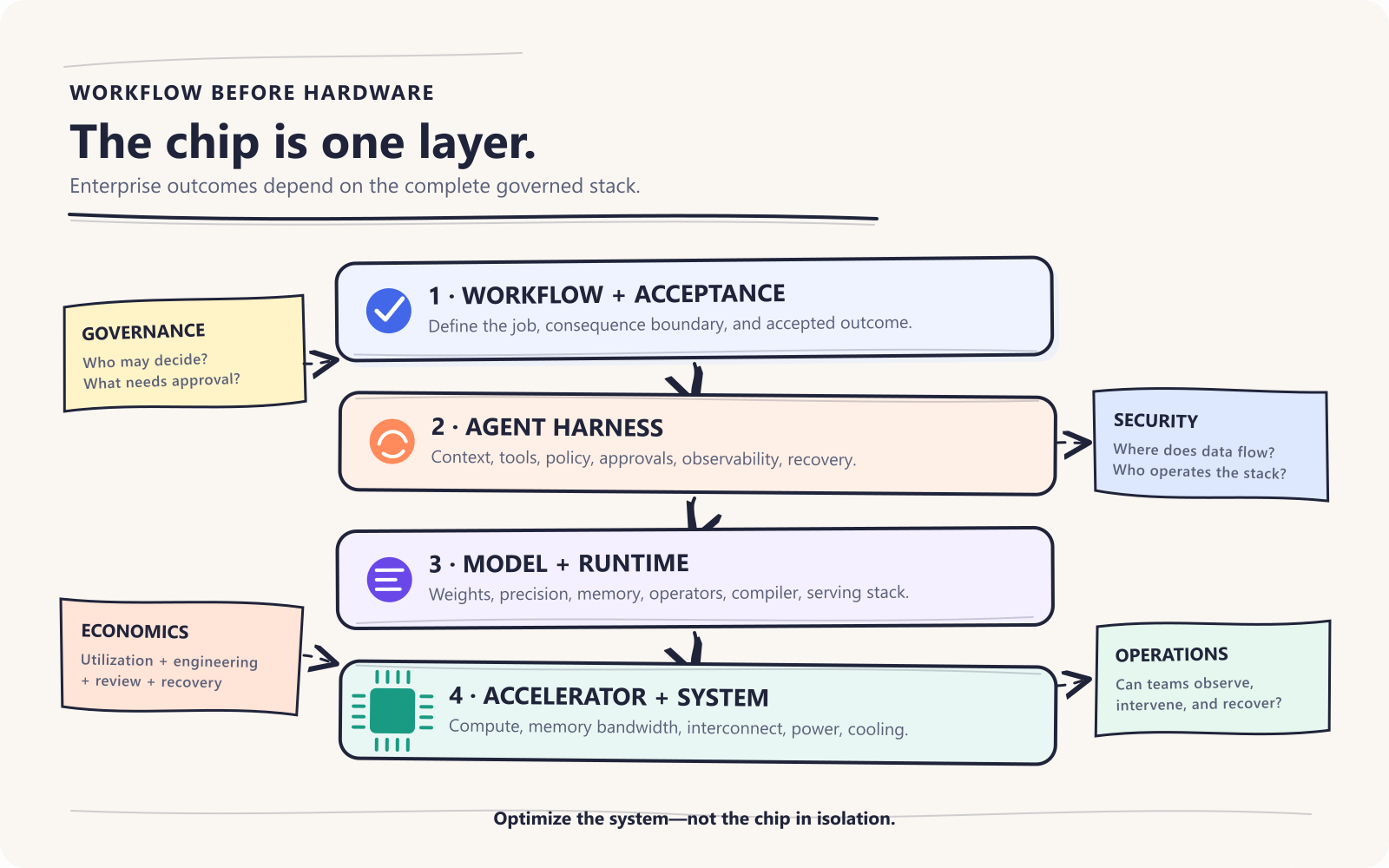
A good chip cannot repair a badly chosen workflow, weak evaluation, missing approval boundary, or unavailable model. But the wrong infrastructure can make a sound agent design too slow, too expensive, too difficult to govern, or impossible to operate where the organization needs it.
First distinction: training is not inference
“AI hardware” hides two different jobs.
Training and post-training require forward and backward passes, gradients, optimizer states, checkpoints, and sustained communication across many devices. This puts extreme pressure on memory capacity, memory bandwidth, interconnects, collective operations, and fault tolerance.
Inference serves an already trained model. It has at least two distinct phases: processing the prompt and generating tokens. Prompt processing can favor raw parallel compute; token generation is often constrained by memory movement, batching, cache management, and the latency promised to each user.
Reasoning models complicate the distinction. More test-time computation can increase the amount of inference performed for a single accepted response. Agentic systems compound it again by calling models repeatedly. An accelerator optimized for large batched throughput may be economically impressive while still feeling slow in an interactive, sequential agent workflow. A low-latency inference system may be excellent for serving but irrelevant for training a frontier model.
This is why a single “petaFLOPS” number rarely settles an enterprise decision.
Second distinction: a closed model is not your workload
If an enterprise uses Claude, a proprietary GPT service, or a hosted Gemini model through an API, it normally does not receive the model weights. It cannot take that model and install it on a preferred GPU, TPU, or local appliance.
The enterprise is buying a service outcome:
- model capability;
- API behavior;
- latency and throughput tiers;
- data-handling commitments;
- regional availability;
- quotas and reliability;
- commercial terms.
The provider decides which accelerators, kernels, schedulers, caches, and quantization techniques run underneath that service.
Hardware choice becomes direct when the organization has deployable model weights: an open-weight model, a model it trained, a licensed enterprise model that permits self-hosting, or a smaller specialized model it owns. Only then can the team meaningfully decide to run it on NVIDIA, AMD, TPU, Trainium, Groq, Cerebras, or another supported platform.
This produces a useful rule:
Before comparing chips, confirm that you have the right to deploy the model and that the target platform can execute it.
The enterprise accelerator map
The current market is easier to understand as four access models, not as one leaderboard.
1. General-purpose AI GPUs: buy, rent, and move
NVIDIA remains the broadest enterprise path because its CUDA-centered ecosystem reaches training, post-training, inference, simulation, libraries, model servers, OEM systems, and every major cloud. NVIDIA sells complete DGX systems and supports on-premises AI factories through certified servers from OEM partners. Vera Rubin extends that stack into rack-scale systems designed for training and agentic inference.
The advantage is not only the GPU. It is the accumulated software, optimized kernels, tooling, operator coverage, documentation, and available engineering experience. That reduces porting risk.
The tradeoffs are acquisition cost, power and cooling requirements, supply, ecosystem dependence, and the fact that buying a GPU does not guarantee high utilization or economical serving.
AMD Instinct provides the clearest alternative general-purpose path. AMD’s MI400 family and ROCm stack support PyTorch, JAX, ONNX Runtime, vLLM, Triton, and other common tools. AMD lists on-premises server solutions through OEM partners. Its Helios rack architecture is a reference design rather than a single product sold directly by AMD, with partner deployments expected to scale through the second half of 2026.
AMD can reduce dependence on a single accelerator vendor and may offer attractive memory or economics for selected workloads. It still requires teams to validate framework versions, kernels, model-serving behavior, and operational maturity for their exact model.
2. Hyperscaler ASICs: rent the platform
Google TPUs are custom accelerators available through Google Cloud services including Compute Engine, Google Kubernetes Engine, and Vertex AI. Ironwood is designed for large-scale training and inference and is generally available in selected North American and European regions.
TPUs can be compelling for matrix-heavy workloads, large effective batch sizes, embeddings, and models designed around JAX or XLA. They are not universal GPU replacements. Google explicitly identifies poor fits such as frequent branching, high-precision arithmetic, unsupported operations, and custom operations in the main loop. As of August 2026, Google’s software documentation says TensorFlow is not supported on Ironwood; current Ironwood paths emphasize JAX and PyTorch/XLA.
The benefit is access to Google’s optimized infrastructure without owning the physical system. The limitation is equally clear: the enterprise adopts Google Cloud capacity, regions, quotas, XLA compilation, supported framework versions, and operating model. It does not buy an Ironwood card for an independent on-premises cluster.
AWS Trainium follows the same access logic inside AWS. Trainium3 UltraServers are purpose-built for large-scale training and inference and are exposed through EC2. AWS’s Neuron stack integrates with PyTorch and related serving tools. JAX support is marked beta in current Neuron documentation, while older TensorFlow and MXNet paths have moved to archived documentation.
The hardware may deliver good economics for an AWS-native workload, but the migration unit is not “the model file.” It includes compiler support, operators, precision, sharding, kernels, observability, and the team’s ability to diagnose Neuron-specific behavior.
Microsoft Maia 200 is an inference accelerator deployed in Azure. Microsoft says it is using Maia for its own model infrastructure, Microsoft Foundry, Microsoft 365 Copilot, and selected GPT workloads, while previewing an SDK with PyTorch and Triton support. Maia is an example of hardware that can improve the economics of a cloud service without becoming a separately purchasable enterprise appliance.
3. Specialized inference systems: optimize a narrower job
Groq’s Language Processing Unit is designed around predictable, low-latency inference. Enterprises can consume supported models through GroqCloud, use dedicated capacity, or pursue GroqRack on-premises deployments through enterprise channels.
The specialization creates speed, but it also creates a selection boundary. The model must be supported and compiled for the platform. Public and dedicated model catalogs, fine-tuning options, context limits, and enterprise access therefore matter more than a generic statement that the chip “runs AI.”
Cerebras uses a wafer-scale architecture and offers both cloud services and CS systems that can be deployed in customer environments. Its software aims to present large systems as a simpler logical compute target, but production availability still depends on the supported-model and deployment path. Public inference endpoints expose a subset of models; additional models and reserved capacity use dedicated enterprise endpoints.
These platforms can be excellent when the workload matches their strengths. They are not drop-in replacements for every CUDA application, proprietary model, or custom operator.
4. First-party silicon: consume the result
OpenAI’s Jalapeño belongs here today. The company designed it with Broadcom around modern LLM inference, reports results across several open-weight architectures, and plans to deploy it internally by year-end. It also says it will continue using NVIDIA and other partner accelerators.
For most enterprises, Jalapeño is not a procurement option. Its effect will be indirect: API latency, available capacity, reliability, and potentially the cost of OpenAI services.
That is still strategically important. When model providers own more of the stack, they can optimize models, kernels, memory, networking, scheduling, and products together. They can also create deeper service differentiation that customers cannot reproduce merely by renting the same nominal chip elsewhere.
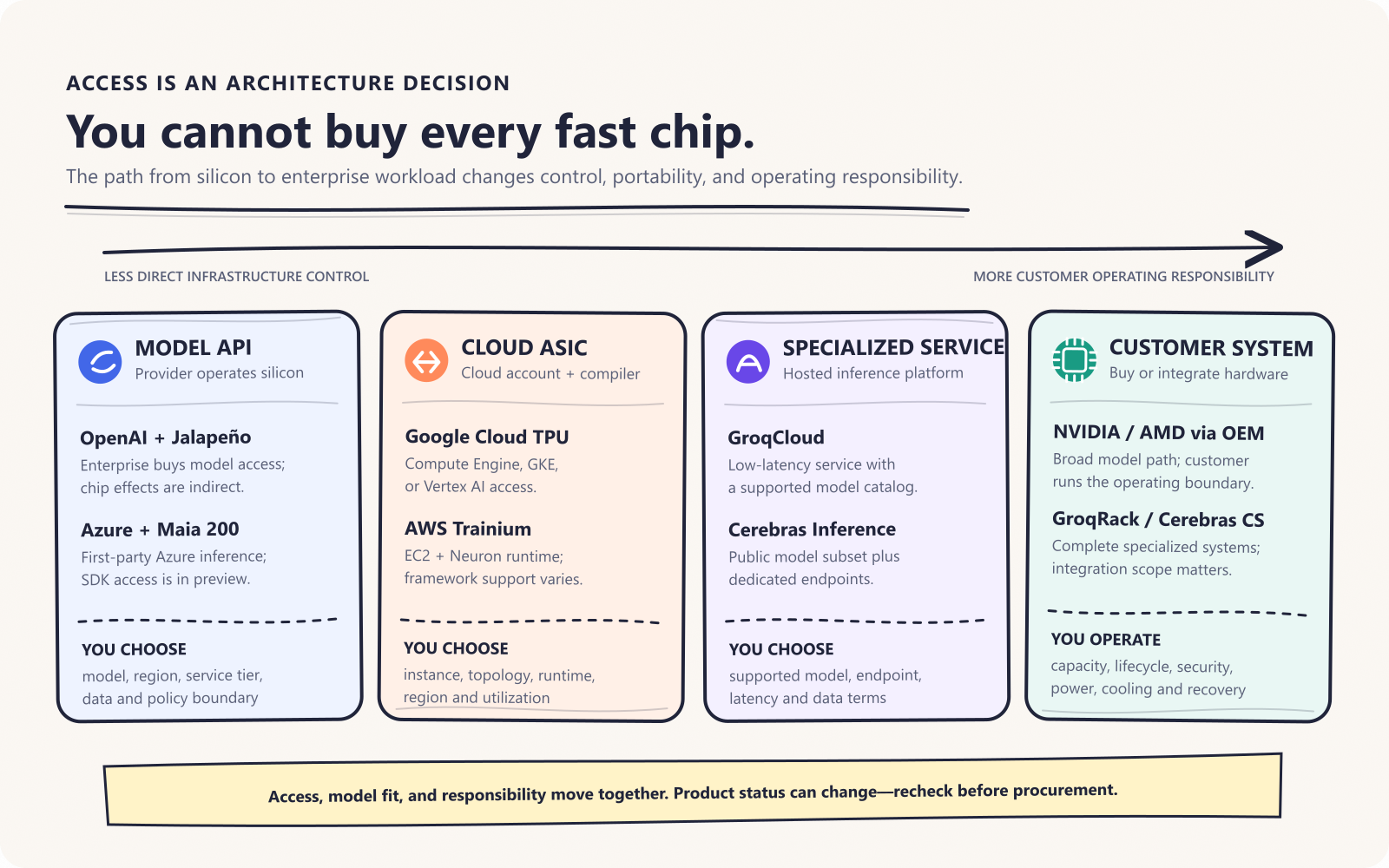
What can an enterprise actually use?
| Platform path | Primary access | On-premises path | Typical fit | Main constraint to validate |
|---|---|---|---|---|
| NVIDIA GPU systems | OEM purchase, cloud, managed service | Yes | Broad training, post-training, inference, custom workloads | Cost, power, cooling, supply, and CUDA dependence |
| AMD Instinct systems | OEM purchase and selected clouds | Yes | Training, inference, HPC, open software stacks | Kernel, framework, and production validation for the exact workload |
| Google TPU / Ironwood | Google Cloud | No general customer-purchase path | Large JAX or PyTorch/XLA workloads, matrix-heavy training and inference | XLA, operators, framework versions, regions, quotas, and cloud dependence |
| AWS Trainium3 | AWS EC2 UltraServers | No | AWS-native large-model training and inference | Neuron compiler, operator coverage, framework maturity, and AWS dependence |
| Microsoft Maia 200 | Azure-operated infrastructure and SDK preview | No announced purchase path | Large-scale cloud inference | Availability, SDK access, workload support, and Azure dependence |
| OpenAI Jalapeño | Planned OpenAI-operated infrastructure | No announced customer access | High-throughput, low-latency LLM inference | Not a direct enterprise deployment option; production qualification continues |
| Groq LPU | GroqCloud, dedicated service, enterprise GroqRack | Yes, enterprise-specific | Low-latency inference on supported models | Model catalog, compilation, context, and workload fit |
| Cerebras WSE / CS systems | Cloud, dedicated endpoints, customer systems | Yes, enterprise-specific | Large-model training and high-speed inference | Model support, system economics, capacity, and vendor-specific operations |
This is a planning map, not a permanent product catalog. Availability, regions, software versions, capacity, and commercial routes change quickly and must be revalidated during procurement.
Not every model fits every accelerator
“It is a transformer” is not a compatibility guarantee.
Teams must validate at least six technical dimensions.
1. Model rights and artifacts
Do you possess deployable weights? Is the license compatible with commercial use, modification, quantization, fine-tuning, and the intended environment? Are the tokenizer, custom code, adapters, and serving artifacts available?
2. Memory, cache, and context
Parameter count is only the beginning. Precision changes weight memory. Long context and concurrent users increase key-value cache requirements. Mixture-of-experts models may activate only part of their parameters per token but still require distributing a much larger model across memory. The system must fit both the weights and the live serving state.
3. Operators and architecture
Attention variants, routing, multimodal encoders, recurrent layers, custom CUDA operations, sparse operations, and dynamic control flow can break an otherwise plausible port. A platform may support common Llama-family models while requiring additional engineering for a new or modified architecture.
4. Precision and accuracy
FP8, FP4, integer quantization, and vendor-specific formats can increase throughput and reduce memory. They can also change accuracy or require model-specific calibration. “Runs at FP4” does not prove that the resulting model clears the enterprise quality threshold.
5. Compiler and framework path
CUDA, ROCm, XLA, Neuron, Maia SDKs, Groq compilers, and Cerebras software solve similar translation problems through different toolchains. PyTorch support can mean native eager execution, a compiler backend, a constrained operator set, or a supported export path. Those are not operationally equivalent.
6. Scale and interconnect
A model that runs on one accelerator may become inefficient across eight, seventy-two, or thousands of devices. Tensor, pipeline, data, and expert parallelism depend on collective communication and topology. At scale, the unit of compute is the system or rack—not the chip.
On-premises is a control option, not a virtue
On-premises AI can be the right architecture when requirements include controlled data location, predictable dedicated capacity, disconnected or restricted environments, existing data-center investment, custom model ownership, or latency close to local systems.
It also transfers responsibility to the enterprise:
- hardware procurement and refresh cycles;
- power, cooling, networking, and physical security;
- firmware, drivers, libraries, and vulnerability management;
- cluster scheduling and capacity utilization;
- model serving, scaling, evaluation, and rollback;
- identity, secrets, logging, and incident response;
- staff with the skill to operate the full stack.
A lightly used accelerator cluster can be more expensive than an apparently costly API. A cloud deployment with weak data controls can be unacceptable even when its token price is low. A self-hosted open model can reduce one vendor dependency while creating new dependencies on hardware, toolchains, systems integrators, and scarce operators.
Governance is not a location. It is an operating system of policy, technical controls, evidence, and retained authority.
The real cost unit is the accepted workflow outcome
Chip price, chip-hour price, and token price are useful inputs. None is the complete economic unit.
For an agentic workflow, total cost includes:
- model inference and any reasoning tokens;
- idle and peak capacity;
- prompt processing and cache behavior;
- retrieval, storage, and network movement;
- orchestration and tool calls;
- compilation and porting engineering;
- evaluation and quality monitoring;
- failed runs, retries, and fallbacks;
- human review and exception handling;
- security and compliance operations;
- infrastructure depreciation or provider commitments;
- migration and exit costs.
The meaningful denominator is an accepted workflow outcome: a completed result that clears the required quality, latency, governance, and human-approval threshold.
A TPU can reduce cost on a workload that maps well to XLA, reaches sufficient scale, and uses available capacity. It does not reduce cost merely because the word “TPU” appears in the architecture. The same is true of a GPU, Trainium system, inference ASIC, or on-premises cluster.
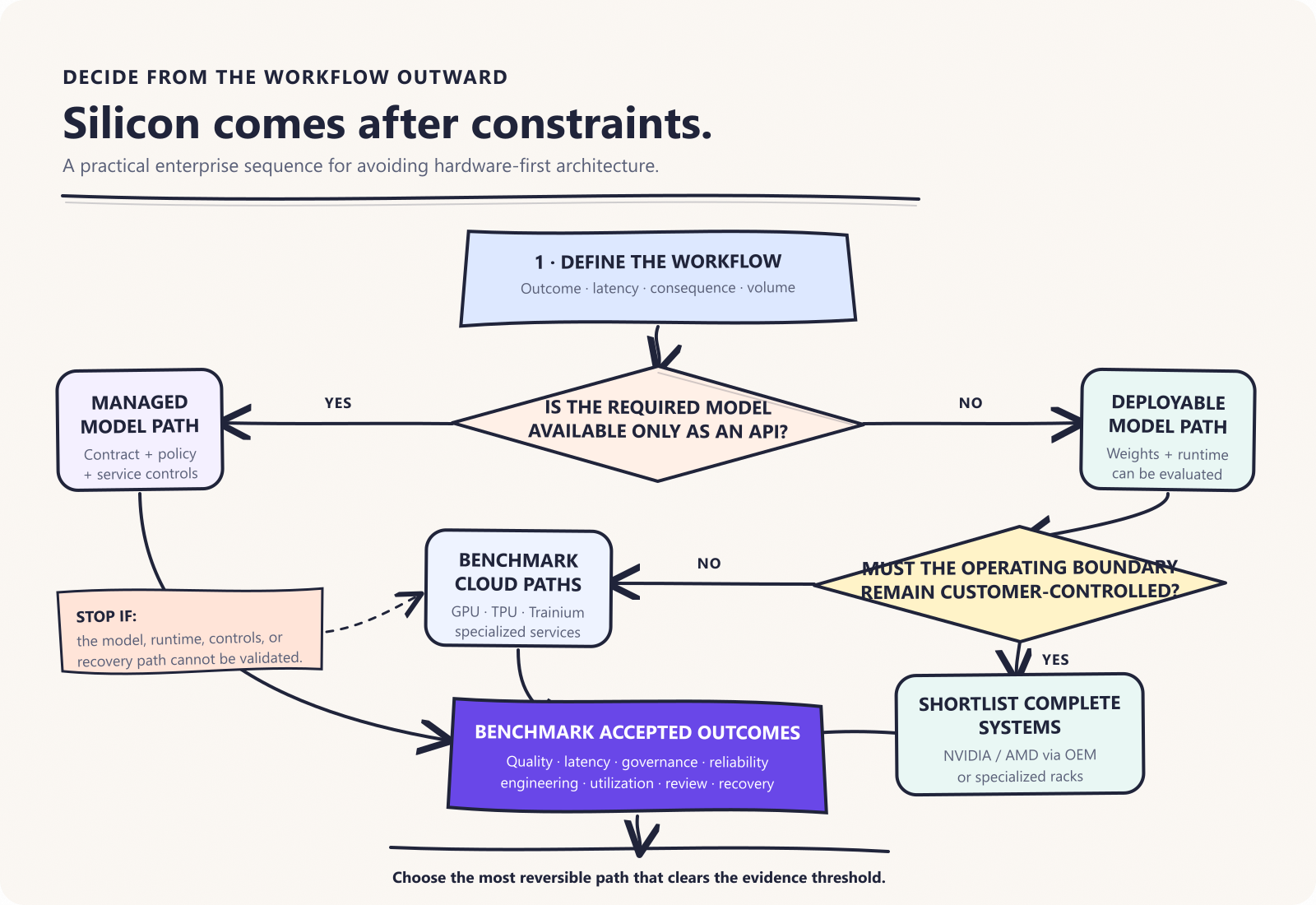
A practical enterprise decision sequence
The hardware decision should come late enough to be informed and early enough to shape the architecture.
- Define the workflow and retained human authority. Identify the decisions, actions, data, exceptions, and consequences.
- Define the accepted outcome. Set quality, latency, availability, throughput, auditability, and recovery requirements.
- Classify the model path. Closed API, licensed hosted model, deployable open weights, internally trained model, or a routed combination.
- Set the deployment boundary. Public cloud, dedicated cloud, sovereign region, colocation, on-premises, edge, or hybrid.
- Build a representative evaluation. Include normal cases, long context, concurrency, dirty data, rare exceptions, and failed dependencies.
- Shortlist complete systems. Model, runtime, compiler, accelerator, interconnect, serving layer, observability, and operating support.
- Benchmark the real trajectory. Measure end-to-end task completion rather than isolated tokens per second.
- Model total cost and utilization. Include engineering, idle capacity, commitments, review, failure, and change.
- Test governance and recovery. Verify data flows, access boundaries, evidence, rollback, and the ability to switch or fail over.
- Preserve optionality where it matters. Use interfaces, evaluations, routing, and portable data practices that prevent one hardware decision from becoming an irreversible operating model.
What this means for Agentic Transformation
The future enterprise will not run one model on one chip.
It will likely use a heterogeneous operating architecture:
- closed frontier services for selected high-capability work;
- open or licensed models where control and deployment flexibility matter;
- smaller specialized models for bounded, repetitive steps;
- deterministic software where no model is required;
- cloud accelerators for elastic or large-scale workloads;
- dedicated or on-premises capacity where governance, latency, or economics justify it;
- routing and evaluation to decide which path handles each case;
- people retaining policy, material decisions, approvals, and exceptions.
Choosing that architecture is not a one-time hardware purchase. It is part of Discover & Redesign, Build & Integrate, Govern & Control, and Operate & Improve.
Flashback is service-led and product-enabled. In an Agentic Transformation engagement, the objective is not to push every enterprise toward one provider, one model family, or one deployment ideology. It is to distinguish the constraints that matter for that company’s workflows and then evaluate the complete operating system around them.
Our AI Operations and Token Efficiency work covers model selection, routing, usage visibility, budget controls, and measurable operating loops. Our Agent-Native Software Development work connects models and agents to the software, tools, observability, and human controls required for bounded enterprise action.
No architecture guarantees savings, security, compliance, or quality. Those outcomes depend on the workload, baseline, evidence, design, and operation.
But the decision can be made rigorously.
The fastest chip is not the architecture
Jalapeño is news because it shows how far full-stack optimization can move inference speed and efficiency. It is more important because it reveals the direction of the market: model providers, hyperscalers, chip companies, and specialized inference platforms are optimizing different parts of the same stack.
Enterprises need enough hardware literacy to see through the benchmark headlines.
They must know whether they are buying a model service, renting an accelerator, purchasing a system, or accepting a toolchain. They must know whether their model can move, whether their data can move, and whether their team can operate the destination. They must evaluate governance and security with the same seriousness as throughput and cost.
The winning choice will rarely be the chip with the largest number on a slide.
It will be the complete system that produces accepted outcomes, inside the right boundaries, with an operating model the enterprise can sustain.
If you are defining that model, hardware, deployment, and governance strategy for an agentic workflow, book a call with Flashback.
Sources and publication note
The Jalapeño facts and benchmark figures come from OpenAI’s August 25 results and its June 24 announcement with Broadcom. OpenAI’s benchmark results are first-party measurements and are qualified as such throughout the article.
Current platform and access descriptions were reviewed from official materials for NVIDIA enterprise AI factories, NVIDIA Vera Rubin, AMD Instinct MI400, Google Cloud TPU, Google’s TPU workload guidance, AWS Trainium3, AWS Neuron framework support, Microsoft Maia 200, GroqRack, and Cerebras inference models.
Sources were reviewed on August 26, 2026. Hardware availability, regions, quotas, prices, software support, and model catalogs are time-sensitive. Vendor specifications and comparisons describe the vendors’ own platforms and do not imply a commercial relationship with Flashback.

Read & review
Article notes
A closer look at the ideas in this article.
Quick summary
OpenAI's first custom inference chip makes the hardware race visible, but enterprises rarely choose a chip in isolation. This article distinguishes hardware that can be bought from infrastructure that can only be rented or consumed through an API, explains why model architecture and software support constrain portability, and provides a governance, security, and cost framework for Agentic Transformation decisions.
Key takeaways
- The fastest accelerator is not automatically the most usable enterprise platform.
- Closed-model customers usually buy an API outcome, not direct access to the underlying chip.
- NVIDIA and AMD offer the clearest on-premises paths; TPU, Trainium, Maia, and Jalapeño are tied to provider infrastructure.
- Model compatibility depends on memory, precision, operators, compilers, frameworks, and interconnects—not only parameter count.
- Evaluate cost per accepted workflow outcome, including engineering, utilization, review, and recovery—not only token or chip-hour price.
Who this is for
CTOs, CIOs, infrastructure executives, platform leaders, AI engineering leaders, and teams planning governed enterprise agent systems.
Why it matters
Agentic systems call models repeatedly, combine them with tools and enterprise data, and may require low latency, controlled data movement, and predictable capacity. Hardware and deployment choices therefore become operating-model decisions.
How Flashback helps
Flashback helps enterprises evaluate workflows, model and infrastructure options, routing, governance, and operating controls as one Agentic Transformation decision rather than as isolated procurement choices.
About Flashback
Flashback is an Agentic Transformation Company. We help companies redesign enterprise workflows so agents can use permitted context and existing systems for bounded actions while people retain policy, material decisions, approvals, and exceptions.
FAQ
Can an enterprise buy a Google TPU for its own data center?
Google exposes current TPUs through Google Cloud services such as Compute Engine, GKE, and Vertex AI. They are not presented as general-purpose accelerator cards for customer-owned data centers.
Can every AI model run on every accelerator?
No. Portability depends on supported operators, precision formats, memory, interconnect, compiler behavior, framework versions, and whether the model weights are available at all.
Does on-premises AI automatically improve security?
No. On-premises deployment can strengthen data-location and infrastructure-control options, but the organization also inherits patching, identity, physical security, model operations, observability, capacity planning, and incident response.
Should enterprises choose hardware before choosing a model?
Usually no. Start from the workflow, accepted outcome, governance boundary, latency, capacity, and model-rights constraints. Then compare complete deployable systems that meet those requirements.
Why does hardware matter more for Agentic Transformation?
Agent workflows often make many sequential model and tool calls. Latency, availability, data movement, and cost can compound across the trajectory, making the serving architecture part of the operating design.