AI Moves Fast. Can You Trace It?

Your team can generate more code. Can it explain what reached production?
Model launches give engineering leaders a steady stream of capability claims. The operating questions deserve the same attention: which decisions can a team delegate, what evidence makes the result acceptable, and who can reconstruct what happened when something goes wrong?
Those questions sit between buying an AI tool and building an agentic workflow that a company can depend on. Recent Atlassian research gives that gap a useful empirical starting point.
What engineering leaders say is missing
In its September 3 analysis of The Agentic Pivot, Atlassian reports:
| Signal | Reported finding |
|---|---|
| Need for a governed engineering system of work for AI | 88% of engineering leaders say they need one; 19% say they have built one. |
| Code generation and review | 74% report accelerated code generation; 78% say their teams still use the same traditional peer-review process. |
| Decision reconstruction | Only 15% of engineers and 25% of leaders are very confident they could reconstruct the reasoning behind an AI-assisted decision six months later. |
These are different measures. The last finding concerns confidence in reconstruction; it does not mean the remaining respondents distrust all AI output. Nor does retaining peer review establish that a team has automated nothing, or prove why it has kept that process.
The report’s methodology identifies two independent surveys conducted by Prolific for Atlassian in Q2 2026: 364 engineering leaders and 750 individual contributors. The leadership group includes managers, Heads of Engineering, directors, VPs, CTOs, and founders; 71% are engineering managers. Results are self-reported perceptions, not an audit of delivery performance. The publication is recent; the fieldwork predates it.
For Flashback, the practical question these findings raise is how a company turns individual tool use into work that other people can inspect, approve, and carry forward.
Better code still needs an acceptance process
There are credible examples of AI producing more efficient implementations. In its May 2025 AlphaEvolve report, Google DeepMind describes a 23% speedup to a matrix-multiplication kernel used in Gemini, contributing to a 1% reduction in training time. It also reports up to a 32.5% speedup for a FlashAttention kernel implementation.
These are specific optimization results reported by the system’s developer, not a general benchmark proving that machine-written software is better than human-written software. AlphaEvolve combines program generation with automated evaluators. Its results demonstrate what can become possible when a task has measurable criteria and candidate solutions can be checked.
That distinction is useful in an ordinary engineering organization. A faster function may still violate a compatibility requirement. A passing test suite may omit a customer-specific edge case. A clean refactor may change an assumption that another service depends on.
The right response is to make those requirements testable wherever possible, then preserve explicit judgment where they remain ambiguous. Automatically rejecting code because an agent wrote it wastes potential. Automatically accepting it because an agent performed well elsewhere transfers an unmeasured risk into production.
The acceptance process should evaluate the work against the company’s requirements, whoever produced it.
Auditability starts while the work happens
Consider an illustrative change to a subscription service. An agent modifies retry behavior after a failed payment. The code compiles and unit tests pass. A reviewer still needs to establish whether the change respects retry limits, avoids duplicate charges, and preserves the company’s customer-notification rules.
A useful review should arrive with evidence already attached:
- the requested outcome and the version of the acceptance criteria;
- the relevant policy, interface contract, and source revisions consulted;
- the proposed diff and the identity of the agent run that produced it;
- tests executed, results, uncovered cases, and unresolved assumptions;
- the approval required for the change and the person who granted it;
- the deployment result and the route to stop or reverse the change.
The engineer can then focus on the remaining judgment. Without that record, reviewing the diff may require rediscovering the business context before any technical assessment can begin.
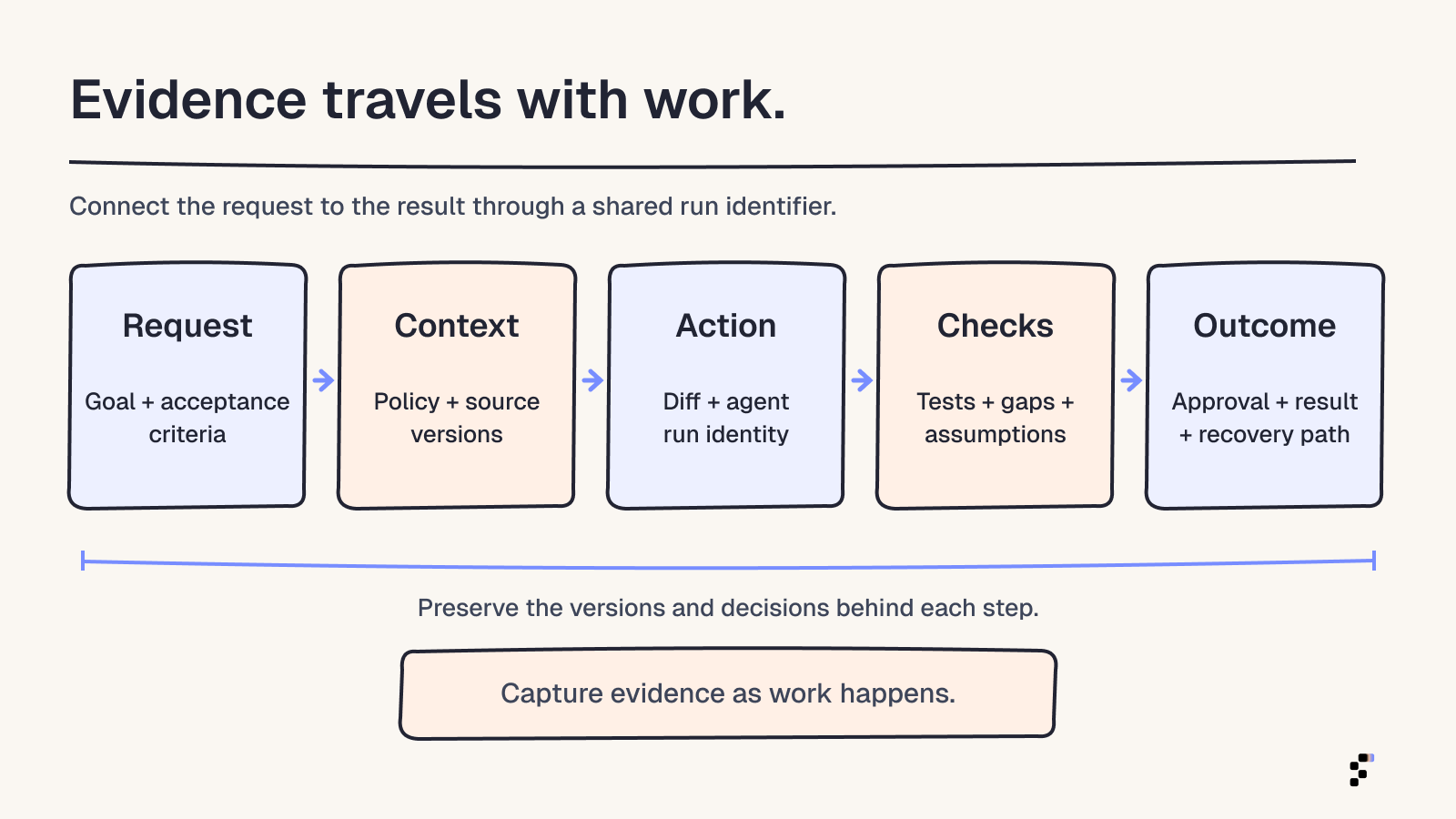
An implementation could connect the ticket, pull request, test run, approval, and deployment through a shared run identifier. It should retain the relevant versions rather than depend on links to documents that later change. Access controls, redaction, and retention rules must also apply to the evidence: an audit trail should not become a second uncontrolled store of customer data or credentials.
This does not require exposing a model’s hidden internal reasoning. A model-generated explanation is a claim to assess. An action log, a retrieved policy version, a test result, and an approval record are observable evidence. Together, they can support an account of the decision’s grounds and execution without pretending to reveal every internal computation.
Auditability also differs from replay. Running the same request later may produce a different result or encounter a different external state. The record must preserve what actually occurred at the time.
Automate the checks that earn their place
Adding another agent to review every agent-generated change is an option, but its judgment needs evaluation too. A second model can share the first model’s blind spots. Agreement alone does not establish correctness.
For the payment-retry example, a practical verification design would combine several kinds of checks:
- Deterministic checks for schema validity, retry bounds, duplicate-processing protection, and forbidden state transitions.
- Behavioral tests covering normal requests, repeated events, delayed responses, and partial failures.
- Agent-assisted review to identify inconsistencies between the proposed change and the supplied requirements, with findings linked to evidence.
- Human approval for material business-rule changes and questions the automated checks cannot resolve.
The team should judge this design on its own cases, including known defects and incidents. It should measure missed problems, false alarms, review time, rework, and escaped defects. A process that produces ten times as many warnings without improving decisions is adding work.
No arrangement guarantees defect-free software. A useful arrangement makes the acceptance criteria explicit, checks them consistently, and identifies who handles the residual uncertainty. Confidence can then grow from observed performance.
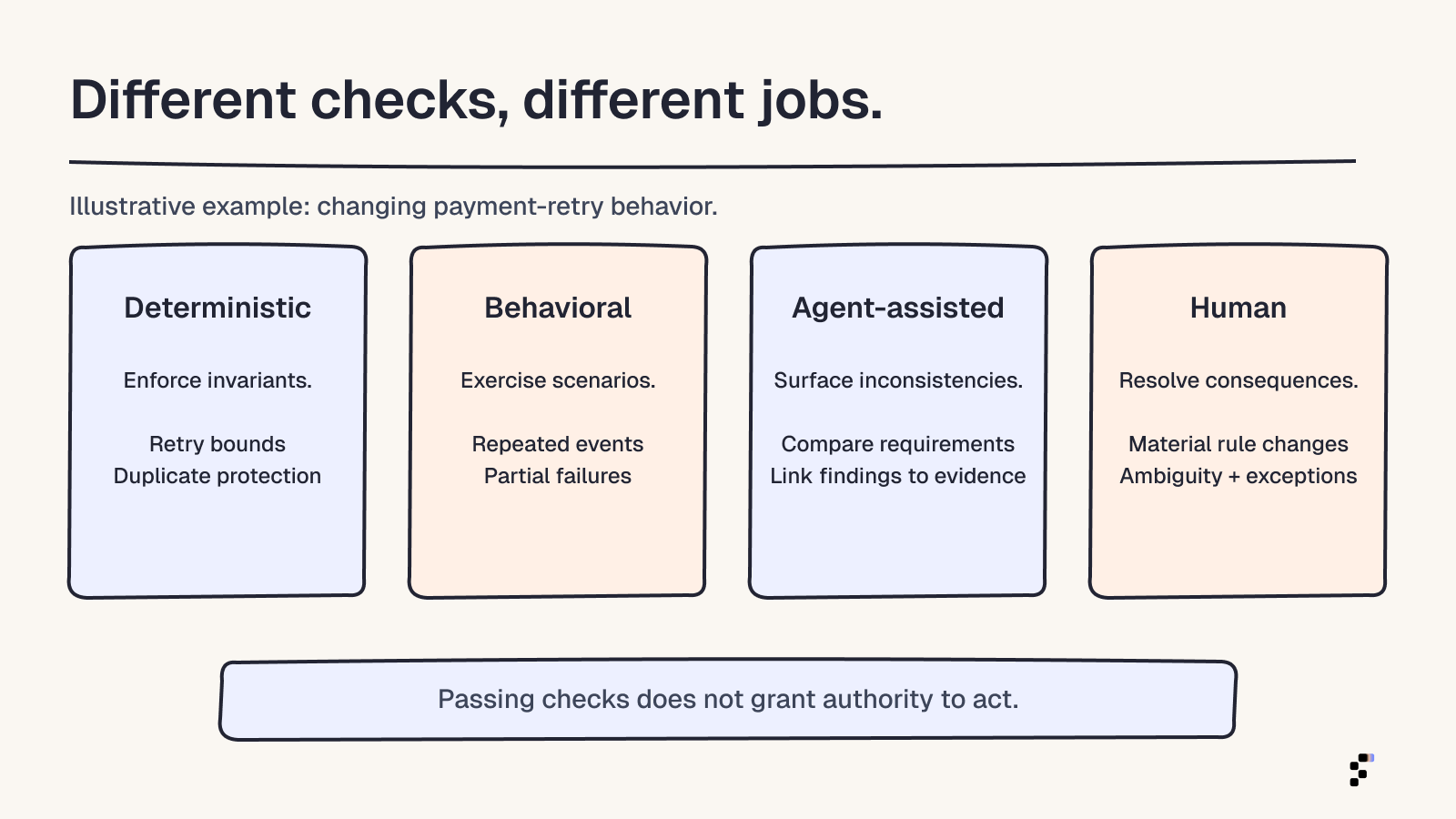
For the retry example, separate two decisions: whether the proposed behavior meets the acceptance criteria, and whether this agent is authorized to apply it. A technically valid change may still need the accountable person’s approval. Record both decisions with the change, including any conditions on execution.
Fit the agent to the business
Two companies can use the same model, repository host, and ticketing system while needing different agent workflows. One releases continuously; another coordinates releases with customers. One can reverse a configuration change immediately; another must repair an external action whose consequences have already occurred.
Those differences determine the context an agent needs, the actions it may take, and the evidence a reviewer must see.
AI should adapt to the company’s operating requirements and the way its people work. The organization should choose any process changes deliberately, based on business value and risk. A tool’s default workflow is a starting configuration, not an operating strategy.
This leaves room for substantial transformation. Manual context gathering can disappear. Repetitive verification can move into automated checks. Teams can change handoffs that create unnecessary delay. What should survive is the purpose of the process: customer commitments, decision rights, quality requirements, and accountability.
The design work is heuristic and use-case-specific: observe actual practice, form a hypothesis about what can be delegated, test it, and revise the boundaries. The resulting execution controls should be explicit and enforceable. Heuristic design is not a reason to leave permissions or approval rules informal.
Identity, logging, policy enforcement, and evaluation infrastructure can be reused. The definition of an acceptable outcome still belongs to the workflow and its accountable owner.
The same questions extend beyond software
The following examples are Flashback’s application of that design approach. The Atlassian survey concerns software professionals; it does not establish adoption or outcomes in these other workflows.
| Workflow | Evidence that should travel with the proposed action | A boundary to define locally |
|---|---|---|
| Cloud cost remediation | Usage window, resource owner, dependencies, expected saving, and recovery procedure | Whether an agent may prepare a change or also execute it |
| Customer-support resolution | Customer request, account context, applicable policy version, and proposed response or remedy | Which exceptions require an accountable person’s decision |
| Supplier onboarding | Submitted documents, validation results, missing information, and applicable approval policy | Who can accept an exception or authorize activation |
The implementation will differ in each case. Even two support workflows can have different consequences depending on the customer, contract, and proposed remedy.
A useful starting exercise is to select one completed case and ask a colleague who was not involved to reconstruct it. Can they identify the objective, evidence, authorization, action, and result? The missing links become concrete implementation requirements for the next version of the workflow.
Where Flashback works on the gap
Flashback’s Agentic Transformation method begins with the operating workflow: the systems people use, the context they gather, the decisions they make, and the exceptions they manage.
Our Agent-Native Software & Operational Workflows service connects agents to that environment through application logic, tools, APIs, and human review. AI Operations addresses the ownership, evaluations, observability, and controls required to keep the system useful in production.
For a scoped engagement, that work can translate into a workflow map, agreed acceptance criteria, a working integration, an evidence trail, and documented approval and handover paths. The deliverables depend on the environment and the responsibilities the company chooses to delegate.
The first objective is a workflow the team can assess and operate. Further autonomy should follow demonstrated quality, usable evidence, and a clear ability to intervene.
Before asking an agent to carry more work, ask whether someone else can understand and validate the work it already carries. That is a practical place to begin building trust.
Talk to Flashback about one workflow your team wants to delegate.
Sources and publication note
Sources reviewed September 7, 2026: Atlassian’s September 3 article, its The Agentic Pivot report, including the methodology on printed page 20, and Google DeepMind’s May 14, 2025 AlphaEvolve publication. The older AlphaEvolve results provide a bounded example of code optimization, not news from the survey’s publication week. Workflow examples and implementation recommendations are Flashback’s analysis, not measured survey findings or customer case studies. Source citations do not imply a commercial relationship.

Read & review
Article notes
A closer look at the ideas in this article.
Quick summary
Adopting AI tools leaves engineering leaders with a practical design problem: how to validate, authorize, and reconstruct the work those tools produce. Flashback examines recent Atlassian research and proposes a workflow-specific approach to evidence, automated checks, human review, and operational accountability, extending from software delivery to company operations.
Key takeaways
- AI usage and a governed delivery process are different capabilities.
- A faster implementation can be valuable; its business suitability still needs independent evidence.
- Auditability requires records of context, actions, checks, authority, and outcomes captured as work happens.
- Reusable controls need workflow-specific acceptance criteria, permissions, and exception paths.
- AI should fit the company's operating requirements, with deliberate process changes where evidence justifies them.
Who this is for
CTOs, Heads of Engineering, VPs of Engineering, platform teams, and operations leaders introducing agents into software delivery and business workflows.
Why it matters
Generating work faster can increase the burden of validation and investigation unless evidence travels with each change. Teams need a practical way to delegate execution while retaining the ability to assess outcomes and intervene.
How Flashback helps
Flashback maps company workflows, connects agents to existing systems, and designs evaluation, permissions, observability, approval, and handover around the people accountable for the work.
About Flashback
Flashback is an Agentic Transformation Company that helps organizations redesign human-operated workflows into agent-operated, human-supervised systems across cloud infrastructure, AI operations, software, and operational workflows.
FAQ
What makes an AI workflow auditable?
An authorized reviewer must be able to connect an outcome to its request, source context, system versions, actions, checks, and approvals. These records should be captured during execution with appropriate access and retention controls.
Does auditability require access to a model's hidden reasoning?
No. Auditability relies on observable evidence and recorded decision grounds. A generated explanation can help a reviewer, but it is not proof of the model's internal reasoning or of the correctness of its actions.
Should every company use the same agent workflow?
Common components such as identity, logging, and policy enforcement can be reused. Acceptance criteria, permitted actions, review boundaries, and exception handling must fit the particular workflow and its consequences.
Does stronger AI coding performance make human review unnecessary?
No. Performance on a bounded task does not establish suitability for a particular business or production environment. Automate checks that can be verified reliably and direct human judgment toward consequential changes, ambiguity, and exceptions.
Flashback resources
Continue exploring
Agentic Transformation
Explore Flashback's method for redesigning workflows around agents under human supervision.
Explore resourceAgent-Native Software & Operational Workflows
Connect agents, application logic, integrations, and review to the way your business operates.
Explore resourceAI Operations & Token Efficiency
Establish ownership, evaluations, observability, and production controls for AI systems.
Explore resource