Small Models vs. Frontier Models: There Is No Best Model

Opinion. This article argues for a decision method. The cited research results apply to specific tasks, models, and protocols; they are neither universal guarantees nor Flashback customer outcomes.
On LinkedIn, the debate over AI models too often collapses into a duel of slogans.
One side says, “Frontier models cost too much.” The other says, “Small models cannot do real work.” Between them sits a more attractive promise: take a small model, add context, RAG, a knowledge graph, a few tools, a planner, specialized agents, and a verifier, and you will match the performance of a frontier model for far less money.
That promise contains an important truth. It also contains a reasoning error.
A well-equipped small model can become an excellent system. It can even outperform a much larger model on a specialized task. But comparing that complete system with a frontier model used almost alone is asymmetric. Give the more capable model the same context, tools, memory, evaluations, and verification loops, and its ceiling moves too.
The right question is not: “small or large?”
The right question is: “What level of capability, inside what system, will produce an accepted outcome at the best total cost and under the required level of control?”
The comparison is often rigged
A model is never deployed in a vacuum. The real system includes at least:
- the base model;
- instructions and context;
- retrieval, document stores, and sometimes a knowledge graph;
- tools, APIs, and execution environments;
- orchestration, routing, and any specialized agents;
- verifiers, evaluations, and correction loops;
- guardrails, approvals, and recovery mechanisms.
The harness can substantially increase effective capability. It can supply facts absent from pretraining, narrow the search space, turn an open request into smaller problems, enforce a structured output, and verify some results. That is not cosmetic. It is useful engineering.
But if we want to know which model to choose, we must compare systems on equal footing:
- the same task and the same difficult cases;
- the same access to data and tools;
- the same prompting and orchestration effort;
- the same quality threshold;
- the same total-cost methodology.
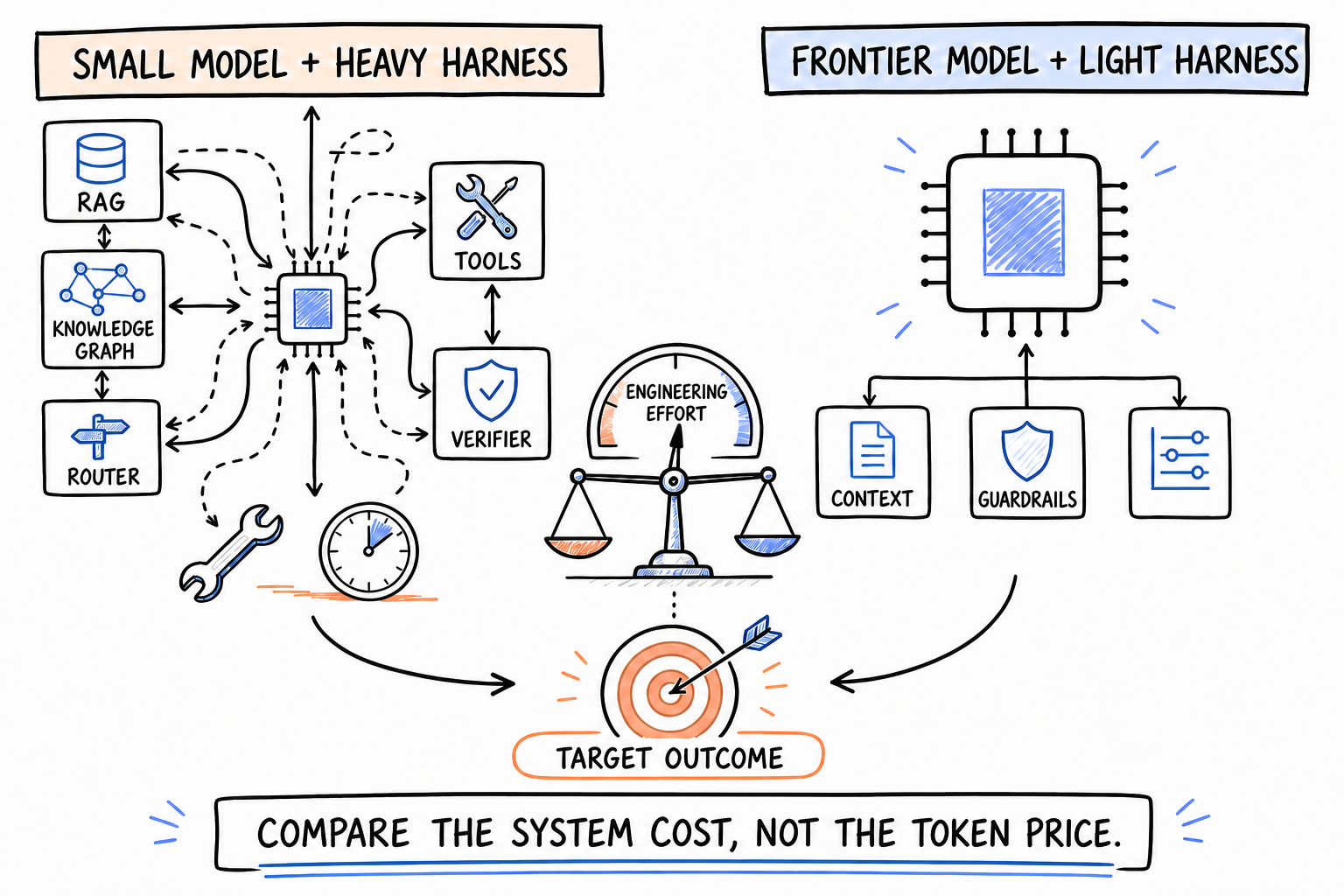
OpenAI’s guide to building agents recommends beginning with the most capable model to establish a baseline, then replacing individual steps with smaller models wherever they preserve acceptable quality. This is a vendor recommendation and should be read as such. The method remains sound: optimize a system after measuring its ceiling, not before.
The strongest case for small models
The counterargument deserves to be taken seriously. NVIDIA Research’s position paper, Small Language Models are the Future of Agentic AI, observes that many model calls inside agentic systems are short, repetitive, specialized, and low-variance. For intent classification, field extraction, selection from a limited set of tools, or execution of a structured policy, an expensive general-purpose model may be unnecessary.
Small models offer real advantages in that territory:
- lower inference cost and latency;
- local deployment or deployment on controlled infrastructure;
- opportunities for specialization and adaptation;
- outputs that can be easier to constrain;
- greater control over data residency in some designs;
- capacity to absorb a high volume of repetitive tasks.
There are also striking empirical results. Snell et al.’s work on test-time compute shows that, under comparable compute budgets, a smaller model with an adaptive inference strategy can outperform a much larger pretrained model — on problems where the smaller model already has a non-trivial success rate.
That final condition is essential. It often disappears from viral summaries.
The harness moves the frontier; it does not erase it
The same study provides the limit to its own result: on the hardest questions, the authors found little additional benefit from test-time compute. In those cases, greater capability from pretraining remained preferable.
In other words, the harness is a conditional multiplier. To multiply something, the system needs a usable signal to begin with:
- a partially correct proposal that can be improved;
- a verifier that can distinguish good from bad;
- a decomposition the model can follow;
- information that can be retrieved from a reliable source;
- an action whose result can be tested.
If the model misunderstands the objective, misses a rare exception, cannot arbitrate across domains, or produces correlated errors on every attempt, more loops may simply multiply tokens, latency, and opportunities to fail.
A frontier model is not infallible. But, all else being equal, stronger base capability provides more room to manage ambiguity, transfer knowledge across domains, plan in an open space, and recover after an unexpected result. The harness then amplifies that capability instead of constantly compensating for its absence.
RAG is not a truth button
RAG and knowledge graphs are particularly useful when an answer depends on private, current, verifiable, or highly specialized knowledge. They can improve traceability and avoid asking the model to memorize what the company already stores elsewhere.
They do not guarantee the quality of the final decision.
The CRAG benchmark simulates web and knowledge-graph search across a diverse question set. In that setting, simple RAG improved the accuracy of the tested models but remained far from complete reliability; even the best evaluated industry systems did not answer every question without hallucination. This result does not describe every RAG system. It simply reminds us that a retrieval pipeline can miss the right source, retrieve noise, or provide context that the model uses badly.
An EMNLP study comparing RAG with long-context models reaches an equally non-ideological conclusion: when resources are sufficient, long context achieved higher average performance in the reported experiments; RAG retained a cost advantage; and hybrid routing preserved comparable performance while reducing compute.
The reasonable conclusion is therefore neither “RAG everywhere” nor “long context everywhere.” It is: route according to the request, then measure the outcome.
Orchestration is not a magic multiplier
The same problem appears in multi-agent systems. Adding roles, steps, and loops creates the appearance of a more intelligent team. Sometimes it does improve the result. Sometimes the team spends its time coordinating.
Google Research evaluated a large, controlled set of agent configurations. Performance tended to increase with more capable models, while the effect of coordination depended on the topology of the work: strong improvement on some parallelizable tasks and sharp degradation on a studied sequential task. More agents do not automatically create more intelligence; they can also introduce information loss, conflicting plans, and accumulating errors.
Anthropic offers a similar recommendation: begin with the simplest solution and add complexity only when it demonstrably improves outcomes. Its guide also presents routing as a way to send straightforward cases to a smaller, cheaper model and difficult cases to more capability.
This should settle part of the false debate: the best design is often not one model, but a heterogeneous architecture.
Equipment does not create the player
The RPG metaphor is useful.
Imagine a rank-C player wearing perfect armor, carrying fifteen potions, three enchanted weapons, and an inventory optimized down to the last slot. On a known, repeatable, bounded mission, that equipment can make the player remarkably effective. In a dungeon that changes its rules, combines several disciplines, and punishes errors of judgment, the loadout does not automatically provide rank-S reflexes.
The harness is the gear. The model is the player’s capability. The task is the dungeon.
Season 4 of Re:Zero offers an almost perfect image of this idea. In episode 6, “Julius Juukulius”, the examiner on the second floor faces an elite swordsman. Julius arrives with talent, training, and an arsenal; his opponent draws a simple pair of chopsticks and neutralizes his swordsmanship. The scene obviously proves nothing about LLMs. It only makes the intuition visible: equipment does not create mastery; mastery can make trivial equipment sufficient.
For an AI system, the lesson is not “do not use tools.” It is more demanding: do not confuse the sophistication of the loadout with the capability of the player. A small model can be superbly equipped. That does not automatically give it the judgment of a more capable model on an open, ambiguous, or unforeseen mission.
The analogy has a limit: in AI, the equipment can genuinely modify the task. Retrieval can supply missing knowledge; a compiler can verify code; an orchestrator can divide the work; a schema can remove ambiguity. But when quality depends on open-ended judgment, cross-domain synthesis, long-horizon planning, or a response to unanticipated events, the player’s capability becomes decisive again.
And unlike an anime hero who restarts with every memory intact, a retry is not guaranteed learning. Without a new signal, the system can repeat the same mistake in different words — while billing one more attempt.
The AI model trilemma
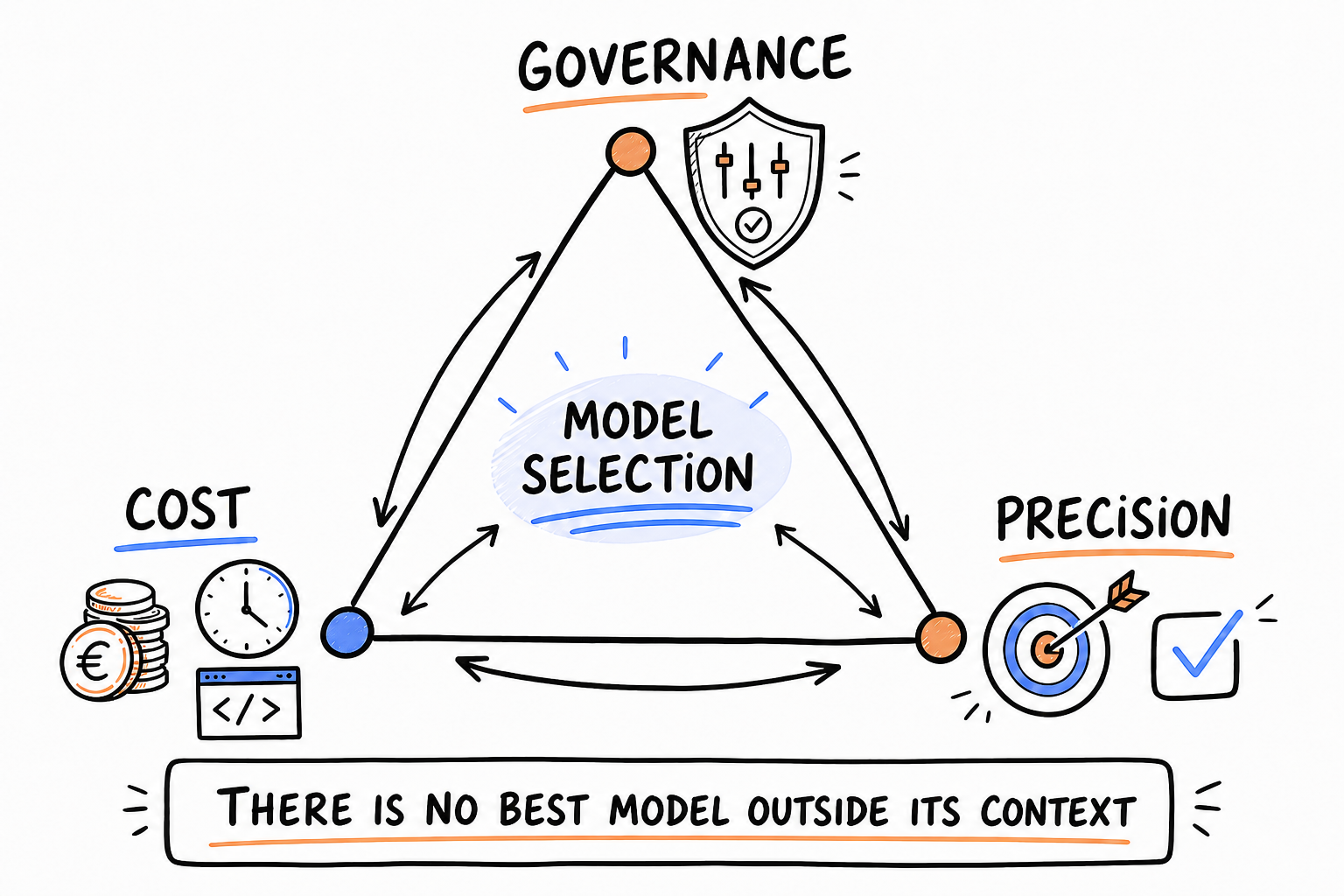
Model selection can be represented as a trilemma. Its three vertices are governance, total cost, and reliable accuracy.
1. Governance
This vertex covers data residency, confidentiality, auditability, reversibility, vendor dependence, local deployment, approvals, and action governance.
A locally deployed small model may be the best choice even when its raw quality is lower because governance dominates the decision. Conversely, a complex, fragile local chain that requires constant review is not automatically more sovereign: the organization must also possess the skill and capacity to operate it.
2. Total cost
Token price is only one line item. Total cost also includes:
- retrieval and storage;
- building and maintaining a knowledge graph;
- tool calls and verifiers;
- retries and fallbacks;
- latency and infrastructure;
- evaluations and observability;
- correction and human review;
- the cost of change when data, models, or providers evolve.
The right unit is not “dollars per million tokens.” It is cost per accepted outcome.
3. Reliable accuracy
This is not the average score on a general benchmark. It is the probability of producing an accepted outcome on the real workflow, including exceptions, imperfect data, long decisions, and the consequences of error.
Reliable accuracy includes robustness, adaptation, reasoning quality, and the ability to use tools correctly. It does not demand the largest model on principle; it demands the system that clears the quality threshold on real cases, including the hardest ones.
Task difficulty is not a fourth vertex. It is the force that moves the optimal point inside the triangle. The more ambiguous, long-running, non-deterministic, and cross-domain the work is, the more it pulls toward reliable accuracy. The more repetitive and high-volume it is, the more it pulls toward cost optimization. The more it touches sensitive data, decisions, or infrastructure, the more it pulls toward governance.
Choose the team as you would for a dungeon
| Mission rank | Work profile | Reasonable starting architecture |
|---|---|---|
| C | Extraction, classification, structured transformation, stable rules | Small model or deterministic solution, constrained outputs, simple tests |
| B | Document questions, known tools, limited exceptions | Small or mid-sized model with RAG, verification, and measured fallback |
| A | Ambiguous analysis, multiple domains, planning, consequential actions | Highly capable model as orchestrator, governed tools, human approvals |
| S | Cross-functional coordination, evolving objective, long trajectory, high uncertainty | Frontier model or best demonstrated capability, complete harness, smaller specialists, observability, and recovery |
This table is not a scientific taxonomy. It is a framing device. A rank-C dungeon does not need a rank-S team. But sending a rank-C team into a rank-S mission and compensating with more and more potions can cost more than selecting the right capability from the start.
The best system is often a mixed team
The most robust architecture looks less like “small versus large” and more like a team:
- a router estimates difficulty and risk;
- small models execute repetitive, well-constrained tasks;
- deterministic tools calculate what can be calculated;
- RAG or a knowledge graph supplies verifiable knowledge;
- a more capable model handles ambiguous, rare, or open-ended cases;
- evaluations determine whether an answer is acceptable;
- a human approves actions whose consequences matter.
In this design, the frontier model is not necessarily called everywhere. It serves as reserve capability, orchestrator, or escalation path. Small models are not devalued: they are placed where their cost, latency, and control advantages are real.
A practical decision method
A team can avoid months of debate with six steps:
- Define the accepted outcome. Specify the required quality, latency, risk, and level of control.
- Build a real evaluation set. Include common cases, exceptions, dirty data, and high-stakes situations.
- Establish the capability baseline. Use the most capable model with a simple, sufficient harness.
- Measure complete cost. Count model calls, tools, retries, latency, maintenance, evaluation, and human review.
- Step down deliberately. Replace the model with a smaller one wherever the accepted-outcome rate remains above the threshold.
- Route the exceptions. Preserve a path to greater capability and to a human when uncertainty or consequence requires it.
This method avoids two expensive mistakes: oversizing the entire chain, or over-engineering around a model whose ceiling will never reach the expected outcome.
What this changes for companies
AI agents are not the goal. Operating leverage is.
For Flashback, model selection should never be isolated from the workflow, governance, budget, and software around it. Our work in AI Operations and Token Efficiency covers model selection, routing, usage visibility, budget controls, and measurement loops. Our Agent-Native Software Development approach integrates agents, tools, observability, and human controls into the operating model from the start.
That does not guarantee a quantified cost reduction or universal quality. Outcomes depend on the workload, baseline, data, architecture, and approved scope.
The objective is simpler: build a controlled system that applies the right amount of intelligence in the right place — and can prove it through evaluations.
There is no best model. There is a best balance.
A small model can be the best choice. A frontier model can be the best choice. A hybrid system can outperform both.
What is not serious is drawing a conclusion from one dimension: token price, model size, number of agents, the presence of a knowledge graph, or one isolated score.
The right system balances governance, total cost, and reliable accuracy. It starts with the real difficulty of the work. It measures cost per accepted outcome. It uses small models where they are sufficient, frontier models where they are necessary, and the harness to make the whole system more useful, visible, and governable.
The model is neither the hero, nor the armor, nor the dungeon. It is part of the team. Engineering means assembling the right team for the right mission.
If you need to establish that baseline, design a routing strategy, or review the total cost of an agentic system, book a call with Flashback.
Sources and publication note
This opinion draws on OpenAI’s agent model-selection guide, NVIDIA Research’s position paper on small language models in agentic systems, Snell et al.’s study of test-time compute, Google Research’s evaluation of a large set of agent configurations, the CRAG benchmark, the EMNLP study comparing RAG and long context, Anthropic’s guide to building effective agents, and OpenAI’s framework for cost per useful outcome. The Re:Zero analogy is based on the public synopsis of episode 72; it illustrates the editorial argument and is not technical evidence.
The sources were reviewed again on August 9, 2026. Vendor recommendations are used as primary sources for their own methods and are compared with external research. The findings remain limited to the models, tasks, and protocols studied. Citing these organizations does not imply a commercial relationship with Flashback.
Read & review
Article notes
A closer look at the ideas in this article.
Quick summary
This opinion article challenges the asymmetric comparison between a heavily tooled small model and a frontier model used on its own. Research shows that RAG, test-time compute, and orchestration can shift the performance curve, especially on tasks the base model can already handle, but they do not eliminate the need for capability on difficult problems. The proposed framework balances governance, total cost, and reliable accuracy, then recommends a heterogeneous architecture guided by real evaluations.
Key takeaways
- Comparing a small model with a full harness against a frontier model without one is an asymmetric test.
- RAG, knowledge graphs, tools, and test-time compute can increase effective capability, but they do not guarantee truth or reasoning beyond the base model's reach.
- The relevant cost is cost per accepted outcome: model calls, tools, retries, latency, maintenance, evaluation, and human review included.
- A sound design establishes a baseline with the most capable model, then replaces or routes work to smaller models wherever evaluations show they remain sufficient.
- Model selection is a trilemma among governance, total cost, and reliable accuracy.
Who this is for
CTOs, AI, engineering, platform, FinOps, and innovation leaders who must choose a model architecture for real workflows.
Why it matters
A decision based on token price or harness sophistication can merely shift cost into retries, maintenance, human review, and errors. Conversely, using a frontier model everywhere wastes capability on simple, repetitive work.
How Flashback helps
Flashback helps organizations turn AI agents into operating leverage through AI Operations & Token Efficiency, including model selection, routing, usage visibility, budget controls, and governed production operations. Outcomes depend on the workload, measured baseline, and approved scope.
About Flashback
Flashback is an Agentic Transformation Company that helps organizations redesign human-operated workflows into agent-operated, human-supervised systems across cloud infrastructure, AI operations, software, and operational workflows.
FAQ
Can a small model with RAG outperform a frontier model?
Yes, on some specialized tasks and under some evaluation protocols. That does not demonstrate general superiority: the result depends on the base model, retrieval system, verifier, compute budget, and example difficulty.
Why start with the most capable model?
It establishes a quality baseline. Without one, a team can optimize a cheaper architecture around a ceiling that is too low without knowing how much quality it has surrendered.
Which cost should teams measure?
Cost per accepted outcome: model and tool calls, retries, latency, infrastructure, RAG and graph maintenance, evaluation, observability, correction, and human review.
Should a system use only one model?
Often, no. A robust architecture can route deterministic or repetitive tasks to smaller models while reserving more capability for ambiguous, rare, long-running, or high-stakes cases.
Why is this article in the Insights category?
It presents an argued editorial perspective grounded in qualified research rather than reporting a product announcement or claiming a universal benchmark result.
Flashback resources