The Agentic Transformation Ladder: How to Choose the First Workflow
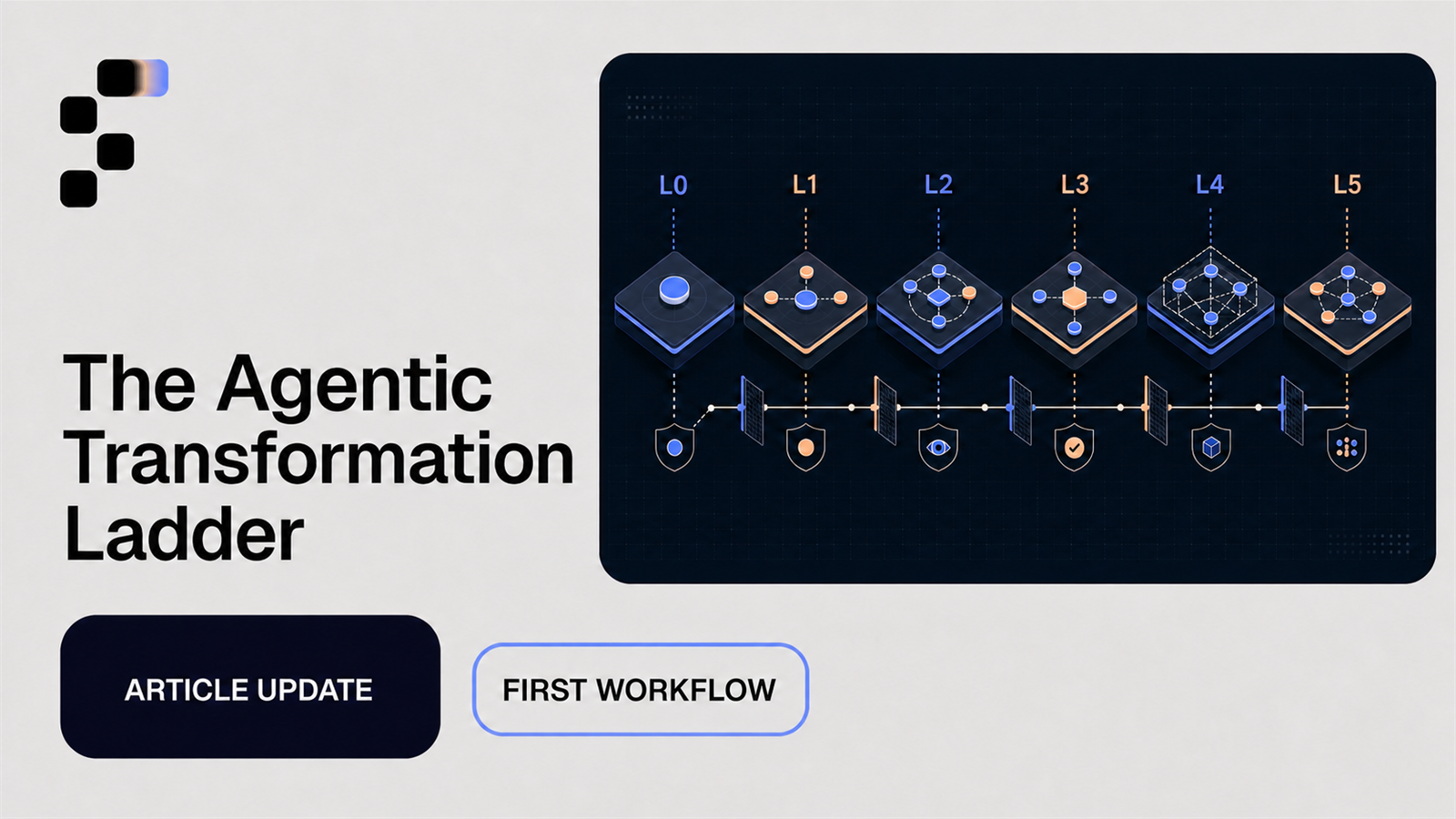

Organizations often begin an AI-agent project with the wrong question:
How autonomous can we make the agent?
That question jumps to implementation before the operating decision has been made. A more useful starting point is:
Which operational responsibility should move to the agent, under what conditions, and what must remain with people?
The distinction matters because a first Agentic Transformation project should not usually be the most complex workflow, the most politically visible process, the highest-risk operation, or the one with the largest theoretical automation potential. Those choices may attract attention, but they also combine unfamiliar technology with difficult organizational conditions.
A stronger first workflow is usually more legible. The work repeats. Its context can be identified. The required tools are available. Decision boundaries can be expressed. Consequences can be limited or escalated. Outcomes can be observed. None of those conditions guarantees success, but together they create a better environment for learning how operational responsibility can move safely.
Flashback’s Agentic Transformation operating model defines the broader shift from human-operated workflows toward agent-operated, human-supervised systems. This article addresses the next question: where should a company start, and how far should the first workflow be allowed to go?
What the Ladder actually measures
Flashback uses the Agentic Transformation Ladder as a practical framework for reasoning about where operational responsibility sits. It is not an industry-standard maturity model, a ranking of companies, or a score for raw model intelligence.
Three ideas need to remain separate:
- Model capability is what a model can do under particular conditions.
- Workflow responsibility is the operational work assigned to an agent or person.
- Execution authority is what the system is permitted to change, trigger, or commit.
A highly capable model can operate at Level 2, where it observes and recommends but cannot execute material actions. A narrower agent can operate at Level 4 for a tightly bounded task if its action classes, permissions, policies, and recovery paths are explicit.
The autonomy level therefore should not come from model marketing. It should come from the workflow, the permissions required, the consequences of action, and the controls surrounding execution.
The six levels of operational responsibility
The Ladder has six levels. Each describes a different allocation of work between people and agents.
| Level | Operating model | Agent responsibility | Human responsibility |
|---|---|---|---|
| 0 | Human-operated digital workflow | No operational responsibility; software supports the process. | People directly operate software and coordinate every material step. People operate. |
| 1 | AI-assisted workflow | Generate, summarize, search, or recommend within a human-operated process. | People operate the workflow and decide how to use the assistance. AI assists. |
| 2 | Agent-observed and agent-recommended | Monitor permitted context and generate recommendations without executing material actions. | People evaluate the evidence and decide what happens next. Agents observe. |
| 3 | Human-approved agent execution | Prepare or initiate actions and assemble the evidence needed for execution. | People explicitly approve material execution. People approve. |
| 4 | Bounded autonomous execution | Execute clearly defined action classes inside explicit policies, permissions, limits, and controls. | People own policy, boundaries, monitoring, exceptions, and accountability. Agents execute. |
| 5 | Coordinated agent operations | Multiple agents or capabilities coordinate across systems and operational domains under shared governance. | People govern the coordinated system, own policy and accountability, and handle consequential exceptions. Agents coordinate. |
The goal is not Level 5.
Higher does not automatically mean more valuable, more mature, or better designed. For some workflows, Level 2 may be the correct permanent architecture because recommendations are useful but the final decision depends on human judgment. Level 3 may provide most of the available leverage by moving investigation and preparation into the agent loop while preserving explicit approval. Level 4 requires clearly bounded action classes. Level 5 introduces coordination complexity across capabilities, permissions, evidence, and exceptions; it should not be treated as the default destination.
The right level is the one that creates useful leverage without assigning responsibility the operating model cannot yet govern.
Choose the next safe level
The Ladder is most useful when it guides a specific transition rather than a distant autonomy ambition.
- Level 0 to Level 1 may improve individual productivity while people continue to operate the workflow.
- Level 1 to Level 2 changes observation and recommendation. The agent begins to monitor permitted context and produce a structured operational view.
- Level 2 to Level 3 moves the agent into action preparation. It can assemble a plan, evidence, dependencies, and execution material, but a person explicitly approves a material action.
- Level 3 to Level 4 moves defined execution authority into policy. Approved action classes may proceed without per-action approval only inside explicit boundaries.
- Level 4 to Level 5 moves from bounded execution in one area toward coordinated agent operations across systems or domains.
At each transition, the useful question is:
What is the next responsibility we can safely and measurably move into the agent loop?
This framing discourages teams from treating autonomy as a feature to maximize. It directs attention toward responsibility, evidence, permissions, consequences, and intervention.
The six signals of a strong first workflow
A first workflow needs enough structure to be redesigned and enough operational value to justify the effort. Flashback evaluates six candidate signals.
1. Repetition
The operational decision, investigation, or coordination should recur often enough that a pattern exists.
A strong signal is repeated context gathering, comparison, routing, or preparation that operators perform in similar ways. A weak signal is a process that is unique every time and depends almost entirely on novel executive judgment.
Repetition does not require every case to be identical. It means the organization can identify a recurring operating shape: common inputs, decisions, handoffs, evidence, or exception types.
2. Context
The information required to perform the task must be identifiable and available from permitted systems.
A strong signal is a known set of billing data, tickets, inventories, records, policies, runbooks, or application state. A weak signal is a workflow that succeeds mainly through undocumented personal knowledge, informal conversations, or data the agent cannot access legitimately.
An agent cannot reason reliably about context the organization has not located, defined, or authorized.
3. Tool access
The workflow’s systems, APIs, interfaces, or execution environments must be accessible through a safe operating boundary.
A strong signal is the ability to provide scoped, observable access to the systems required for the task. A weak signal is uncontrolled access, shared credentials, or a brittle manual interface with no reliable permission or audit boundary.
Tool availability is not permission to expose everything. The target level determines whether access should be read-only, preparatory, approval-gated, or capable of bounded execution.
4. Decision boundaries
The team should be able to explain:
- what the agent may decide;
- what it may recommend;
- what it may prepare;
- what requires human approval;
- what it must never do.
A strong signal is an expressible boundary between routine action, material judgment, and exception. A weak signal is a process where nobody can explain who owns the decision or what an acceptable action means.
Undefined decision ownership is an operating-model problem before it is an agent problem.
5. Risk
Consequences should be understood, limited, observed, reversed where applicable, or escalated to accountable people.
A strong signal includes owners, approval rules, supporting evidence, intervention points, and recovery paths for material actions. A weak signal is a workflow where one incorrect action could create severe irreversible consequences and no effective intervention path exists.
Risk is not merely one checkbox among six. A catastrophic, unbounded downside can disqualify an otherwise attractive first workflow.
6. Measurability
The organization needs to know whether the redesigned workflow performs better.
Depending on the work, useful measures may include cycle time, investigation time, completion rate, exception rate, rework, error rate, operator time, cost per completed task, approval and rejection patterns, or reliability. The appropriate measures should describe the actual outcome, not just agent activity.
An agent producing more messages or actions is not evidence that the workflow improved.
A First Workflow Test
The six signals can be turned into a practical discussion with workflow owners, operators, engineering, security, and accountable leaders.
| Signal | Strong candidate | Warning sign |
|---|---|---|
| Repetition | Similar investigation, coordination, or decision work recurs. | Each case is fundamentally unique and dominated by novel judgment. |
| Context | Required sources are known, accessible, and permitted. | Critical knowledge is undocumented, informal, or inaccessible. |
| Tool access | Scoped access can be granted and observed. | The task requires broad credentials or brittle interfaces with no safe boundary. |
| Decision boundaries | Recommend, prepare, approve, execute, and prohibited actions can be distinguished. | Ownership and acceptable action cannot be explained. |
| Risk | Consequences are bounded, owned, observable, recoverable where relevant, and escalatable. | A plausible error creates extreme or irreversible harm without intervention. |
| Measurability | The team can observe workflow outcomes, exceptions, and required human effort. | Success is vague or measured only by agent activity. |
This is not a numerical score. A workflow with five strong signals and one catastrophic unbounded downside may still be a poor first candidate. Another workflow with modest value but strong observability and safe boundaries may be better for learning how agents behave in the organization’s real environment.
Readiness is a judgment about the pattern across the six dimensions, with consequence and accountability receiving the weight they deserve.
Start with responsibility, not an automation percentage
Saying a workflow is “50% automated” reveals very little about its design. Half of which work? Which decisions? Which consequences? Who remains accountable?
A clearer transformation map names the responsibilities that may move into the agent loop:
- gathering permitted context;
- detecting change;
- investigating;
- comparing options;
- preparing actions;
- routing work;
- executing bounded actions;
- coordinating across systems.
It also names the responsibilities that remain with people:
- setting objectives;
- owning policy;
- making material judgments;
- approving consequential actions;
- handling exceptions;
- retaining accountability;
- designing and changing the system.
This division can be inspected. It gives operators, leaders, and control functions a shared description of how work will change. An automation percentage cannot do that.
Map the supervision states
“Manual versus autonomous” is too coarse for designing an operational workflow. Flashback uses six supervision states as a more useful vocabulary:
Observe → Recommend → Prepare → Approve → Execute → Exception
- Observe: gather permitted context and detect relevant conditions.
- Recommend: propose a next action with evidence and uncertainty where relevant.
- Prepare: assemble the action, dependencies, expected impact, and recovery information.
- Approve: obtain an accountable human decision for material action.
- Execute: act inside the explicitly permitted boundary.
- Exception: pause and escalate ambiguity, policy conflict, failure, or unexpected consequence.
At Level 2, Observe and Recommend dominate. At Level 3, Prepare and explicit Approve become central. At Level 4, Execute may occur without per-action approval for defined action classes, while policy, monitoring, accountability, and exceptions remain governed.
Exception handling remains necessary wherever an agent encounters conditions outside its authority or confidence. The exact implementation will vary, but an operating design that describes only the happy path is incomplete.
Illustrative example: cloud cost anomaly investigation
The following scenario is illustrative. It is not a Flashback customer case study and does not imply that every cloud environment should use the same autonomy level.
Current state: Level 0
An operator opens billing dashboards, compares recent spend, checks resource inventory, identifies unusual resources, searches for owners, examines utilization, determines whether the resource should remain, writes a recommendation, and coordinates the next action.
The process may work, but the operator carries nearly all context gathering, investigation, judgment, and coordination.
First target: Level 2
An agent receives read-only access to permitted billing, inventory, ownership, and utilization data. It monitors for anomalies, gathers resource context, identifies likely ownership, compares recent usage, and prepares an evidence-backed recommendation.
The human still decides whether the evidence is sufficient and what action, if any, should follow. This design can create useful leverage by reducing investigation time without transferring infrastructure execution authority.
Possible progression: Level 3
After the Level 2 workflow becomes observable and reliable enough for its approved scope, the agent may also prepare a change plan, identify dependencies, draft a ticket or approved command, and present expected impact and rollback information.
A human approves every material infrastructure action. The agent carries more preparation; the person retains execution approval and accountability.
Conditional progression: Level 4
Only after clear operating boundaries exist might specific low-risk action classes become eligible for bounded execution. Eligibility would depend on policy, permissions, environment, evidence, monitoring, and recovery. Infrastructure deletion should not become autonomous merely because anomaly detection works.
The lesson is that useful leverage can exist well before maximum autonomy. Teams considering this pattern can explore Agentic CloudOps & Infrastructure and the subordinate Cloud Cost Optimization capability without assuming that every cost workflow should execute changes.
How first workflows differ across Flashback domains
The selection method remains consistent, but candidate work and consequences differ by domain.
Agentic CloudOps & Infrastructure
Incident evidence gathering or cloud drift investigation may be a strong candidate when signals, inventories, owners, and runbooks are accessible. The first target may be Level 2 or Level 3 depending on execution risk, approval requirements, and the quality of the operating boundary.
AI Operations & Token Efficiency
A model-usage investigation, routing recommendation, evaluation triage, or budget anomaly review can move repeated analysis into an agent loop. The appropriate level depends on policy and downstream impact: recommending a routing change differs from applying it across production workloads. See AI Operations & Token Efficiency for the surrounding operational discipline.
Agent-Native Software & Operational Workflows
Multi-system operational intake, evidence gathering, workflow preparation, or exception routing may provide a practical starting point. The design should identify which system actions are preparatory and which carry material consequences. Agent-Native Software & Operational Workflows addresses that broader product and workflow architecture.
These are examples, not prescribed autonomy levels. Each workflow still requires its own responsibility map.
What not to choose first
Poor first candidates often have one or more of these conditions:
- ownership is unclear;
- desired outcomes are undefined;
- the process changes fundamentally every time;
- required context is inaccessible;
- no safe tool boundary exists;
- consequences are irreversible or extreme;
- nobody can define approval policy;
- results cannot be measured;
- exception handling is undefined;
- the organization is trying to automate organizational ambiguity instead of resolving it.
Agents do not repair an undefined operating model by themselves. They can make ambiguity move faster: incomplete context can produce recommendations sooner, unclear ownership can route confusion across more systems, and broad permissions can turn an unresolved policy question into an operational action.
The appropriate response may be to improve the workflow before introducing an agent. Clarifying ownership, documenting context, defining policy, creating an API boundary, or establishing recovery can be transformation work even when agent deployment is deferred.
Define the target before building
Before implementing an agent, the team should document:
- Current workflow: the real sequence of work, including informal steps and handoffs.
- Workflow owner: the accountable person or function.
- Target Ladder level: the intended allocation of responsibility for the first deployment.
- Permitted context: the data and systems the agent may observe.
- Permitted tools: the interfaces and environments it may use.
- Action classes: what it may recommend, prepare, or execute.
- Approval boundaries: which actions require explicit human authorization.
- Exception paths: when and where the workflow pauses or escalates.
- Evidence and audit requirements: what must be recorded before and after action.
- Success measures: the outcomes, exceptions, reliability, and human effort the team will observe.
- Rollback or recovery: how the organization responds when an action fails or creates an unintended result.
This definition turns “build an agent” into an operating proposal that can be reviewed before technology choices obscure the underlying responsibility decision.
Connect workflow selection to the Flashback Method
Within the Flashback Method, first-workflow selection belongs primarily to Discover & Redesign. The output is a Transformation map: current work, target responsibility, systems, context, owners, decisions, permissions, risks, controls, exceptions, and measures.
Build & Integrate then implements the approved context, tools, interfaces, and agent behavior. Govern & Control makes identity, action boundaries, approval, evidence, escalation, and cost controls operational. Operate & Improve observes production behavior, handles exceptions, and determines whether changes are justified.
The target autonomy level is not frozen forever, but it should not drift informally. A change in authority is a change to the operating model and deserves explicit review.
Expand authority deliberately
A deployment that performs well should not automatically receive more authority. Additional responsibility should be earned through operational evidence such as:
- predictable behavior inside the approved scope;
- acceptable and understandable exception patterns;
- reliable policy enforcement;
- useful operator feedback;
- observable workflow outcomes;
- working intervention and recovery paths;
- stable integrations and permissions;
- a clear audit history.
No single signal guarantees that more autonomy is safe. Evidence may instead show that the current level is the correct permanent design, that the scope should narrow, or that the workflow should return to an earlier level while controls improve.
The purpose of operation is not to justify a predetermined autonomy roadmap. It is to learn what allocation of responsibility actually works.
The first transformation is a responsibility decision
Agentic Transformation is not the pursuit of the most autonomous system. It is the deliberate redesign of who carries operational responsibility.
A strong first workflow lets a team move meaningful work into the agent loop, retain accountability, measure the outcome, learn from real operation, and expand authority only when the evidence justifies it.
That is the role of the Ladder: not to point every organization toward Level 5, but to make the next safe level explicit.
Explore the broader Agentic Transformation framework or begin by identifying one workflow whose context, boundaries, consequences, and outcomes can be made clear.

Read & review
Article notes
A closer look at the ideas in this article.
Quick summary
Flashback uses the Agentic Transformation Ladder to reason about where operational responsibility sits across six levels, from human-operated work to coordinated agent operations. This article turns that framework into a practical method for choosing a first workflow, defining the target responsibility level, preserving human accountability, and expanding authority only when operational evidence supports it.
Key takeaways
- The Ladder measures where operational responsibility sits, not model intelligence or organizational prestige.
- The goal is the next safe level that creates useful operating leverage, not Level 5 or maximum autonomy.
- Strong first-workflow candidates show a favorable pattern across repetition, context, tool access, decision boundaries, risk, and measurability.
- Teams should specify which responsibilities move into the agent loop and which remain with people instead of relying on automation percentages.
- Additional authority should follow evidence from operation, policy enforcement, exceptions, recovery, and accountable human review.
Who this is for
This article is for operations, technology, product, platform, AI, and transformation leaders deciding where to begin with enterprise agents and how much responsibility the first workflow should carry.
Why it matters
A poor first workflow can combine unclear ownership, inaccessible context, broad permissions, and unbounded consequences. A deliberate selection process helps teams create useful leverage while preserving approval, accountability, and the ability to intervene.
How Flashback helps
Flashback helps organizations identify high-value workflows, choose an appropriate level of agent responsibility, and redesign the surrounding systems, controls, integrations, and operating model so agents can create measurable leverage under human supervision.
About Flashback
Flashback is an Agentic Transformation Company that helps organizations redesign human-operated workflows into agent-operated, human-supervised systems across cloud infrastructure, AI operations, software, and operational workflows.
FAQ
What is the Agentic Transformation Ladder?
It is Flashback's practical six-level framework for reasoning about where operational responsibility sits, from human-operated digital workflows through coordinated agent operations under shared governance. It is not an industry-standard maturity score or a race toward full autonomy.
What level should an organization start with?
There is no universal starting level. Teams should choose the next safe level that creates useful, measurable leverage for a specific workflow. Level 2 or Level 3 may be the right initial or permanent design when consequences require human judgment or approval.
How do you choose the first workflow for AI agents?
Assess the pattern across six signals: repetition, accessible context, safe tool access, expressible decision boundaries, bounded risk, and measurable outcomes. A severe unbounded downside can disqualify a workflow even when the other signals are strong.
Is more agent autonomy always better?
No. Higher Ladder levels carry different responsibilities and control requirements; they are not inherently better. The appropriate level depends on the workflow, permissions, consequences, evidence, recovery paths, and accountable owners.
What should humans still control in an agent-operated workflow?
People should retain appropriate control over objectives, policy, material judgment, approval boundaries, accountability, exceptions, and system design. The exact division depends on the workflow and may change only as operational evidence justifies it.
Flashback resources