The Next Enterprise AI Layer: Coordinating Work Across Systems

A useful AI layer could help teams assemble the work scattered across applications: matching records, applying a procedure and preparing a decision for a responsible person. Google’s latest healthcare announcement offers a concrete example of that direction. The wider enterprise lesson concerns how work moves between systems.
A customer reports that an industrial machine has failed. The service team needs the support ticket, proof of purchase, the equipment’s serial number and its maintenance history. Each item may exist in a different application. Before anyone can assess the warranty, someone must bring those fragments together.
This is a useful way to think about enterprise AI beyond the chatbot. The application holding each record still matters. But completing the task also depends on connecting those records, understanding their relationship and presenting a usable case to the person responsible.
A new announcement, a broader design pattern
On November 10, 2026, Google announced Gemini for healthcare. Its design combines reusable skills—expert instructions and context—with connectors to existing systems. Google describes workflows that prepare records, assemble supporting material and identify missing documentation. The connectors are described as preserving existing identity and role-based permissions. Google announcement.
Google’s product page specifies a U.S. preview for Gemini Enterprise Standard and Plus customers. It also states that the Epic and Oracle Health connectors are read-only: chart entries, orders and final sign-off remain with clinicians. Those limits matter when interpreting what “coordination” means. Product page.
These are vendor descriptions of a preview, not independent evidence of improved clinical outcomes or a measured business return. The transferable idea is narrower: combine task-specific instructions with permitted access to the information needed for a particular piece of work.
From connected applications to a prepared case
Consider an illustrative industrial warranty process. This is a fictional design example, not a customer deployment or a claim about Google’s industrial capabilities.
An employee asks an agent to prepare a warranty case for review. A reusable skill defines what a complete case needs. Connectors retrieve the relevant records when required. The agent produces a structured dossier for the service manager.
Making this useful requires five distinct elements.
1. Identify the sources. The CRM contains the complaint and customer correspondence. The ERP contains the invoice. An equipment register identifies the installed machine. A maintenance system records inspections and repairs. The design must specify which source answers which question, including what to do when that source is unavailable.
2. Match the same business object. A company name is rarely enough. The invoice may identify a distributor while the ticket names the equipment operator. A serial number may be mistyped. The system needs explicit matching rules and a way to expose uncertain matches. A convincing summary of the wrong machine’s records would make the process worse.
3. Reconcile the vocabulary. “Installation date,” “delivery date” and “warranty start” may refer to different events. A maintenance note describing a recurring symptom does not establish the cause of failure. The dossier should preserve these distinctions rather than compress them into a confident but misleading narrative.
4. Apply the relevant procedure. The skill should identify the applicable policy version, required documents and exception route. If an inspection record is missing, the output should say so. It should not invent a completed inspection or treat silence as evidence of compliance.
5. Prepare the handoff. The manager receives the case summary, linked evidence, unresolved discrepancies, missing items and a proposed next step. The manager decides whether to request information, approve a remedy or refer the case elsewhere. Preparing the dossier does not authorize a refund, replacement shipment or change to the customer’s records.
The output is therefore more specific than an answer in a chat window. It is a reviewable work product with a defined recipient and an explicit state: ready for review, incomplete or blocked.
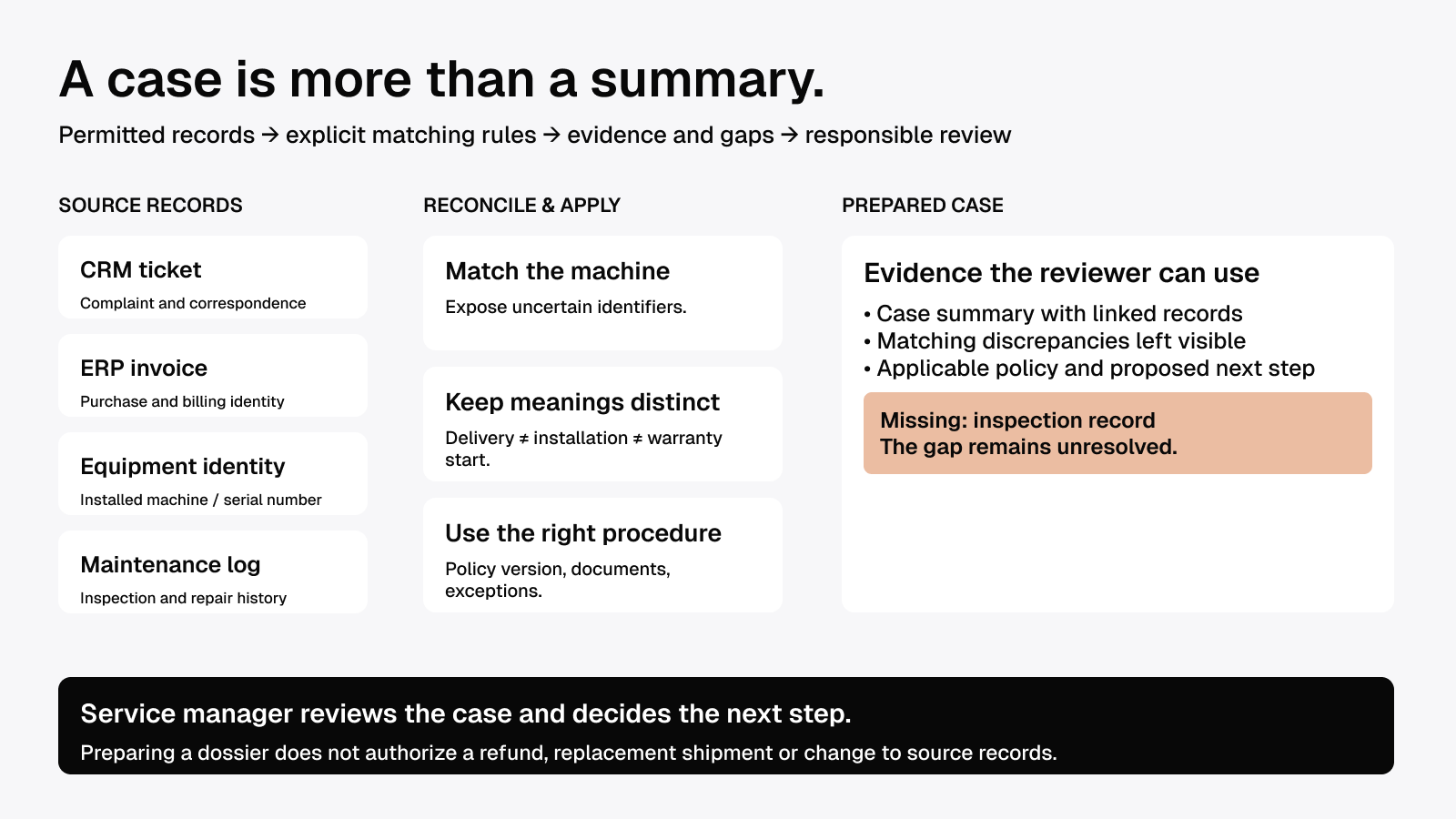
Illustrative warranty workflow; not a product interface or customer deployment.
Read the case, step by step
The diagram can also be read as a short checklist:
- Gather the records. The CRM supplies the complaint and correspondence; the ERP supplies the invoice; the equipment register supplies the installed machine and serial number; the maintenance log supplies inspection and repair history.
- Reconcile the evidence. Match the machine, expose uncertain identifiers, and keep delivery, installation and warranty-start dates distinct. Apply the relevant policy version and exception procedure.
- Show the gaps. The prepared case contains linked evidence, visible matching discrepancies and a proposed next step. In this example, the inspection record is missing: the gap remains unresolved.
- Keep the decision with the reviewer. The service manager reviews the case and decides the next step. Preparing it does not authorize a refund, a replacement shipment or a change to source records.
A connector does not supply business meaning
An API connection can retrieve an invoice. It does not determine which invoice governs the claim, whether the equipment has changed ownership or which maintenance exception applies.
That is where integration and process design remain essential. Teams must map identifiers, document terminology, define precedence between conflicting records and assign responsibility for keeping procedures current. A skill can encode part of that knowledge, but someone must maintain and test it.
Access when needed also does not eliminate every need for data pipelines, search indexes or shared data models. Some workflows require historical analysis or transformations better handled elsewhere. The architecture should follow the task and its constraints.
The opportunity is to make coordination reusable without pretending that every underlying system has become interchangeable.
Measure the handoff, including its failures
The first test should compare prepared cases with the current process on a defined set of representative examples. Include incomplete records and ambiguous matches, not only clean demonstrations.
Four measures would help:
- Re-entry: how much information employees still copy manually between systems.
- Completeness: whether the dossier contains the required evidence, with unavailable items visibly identified.
- Rework: how often reviewers return a case because information is wrong, missing or associated with the wrong object.
- Time to review: elapsed time until a usable case reaches its responsible reviewer.
These are proposed evaluation measures, not results. Faster assembly is not useful if it increases correction work or merely moves the bottleneck to the manager.
The economics remain an open question. Connector development, data cleanup, policy maintenance, model usage and exception handling all contribute to cost. A credible assessment must include those activities and examine performance over time, as systems and procedures change. No savings figure follows from the architecture alone.
What this means for Agentic Transformation
For a workflow already chosen, the next design question is practical: what information must cross application boundaries, how should it be reconciled, and what should arrive on a person’s desk?
Flashback is an Agentic Transformation Company. Agentic Transformation redesigns enterprise workflows around bounded agent actions and retained human authority. In this context, that means designing the work between applications as carefully as the interaction with an AI model.
The next enterprise AI layer may be judged less by how convincingly it talks than by whether it prepares a case another person can actually use.
Read & review
Article notes
A closer look at the ideas in this article.
Quick summary
Google’s healthcare preview illustrates a design pattern: combine task-specific skills with permitted access to existing systems. A fictional industrial warranty case explains the integration work, human handoff and evaluation required.
Key takeaways
- Skills provide task instructions; connectors provide permitted access to source systems.
- Matching identities, reconciling terminology and maintaining procedures remain integration work.
- A prepared case can support human review without authorizing changes to source records.
- Re-entry, completeness, rework and time to review are measures to test, not demonstrated outcomes.
Who this is for
Enterprise CTOs and CEOs
Why it matters
Cross-system workflows need reliable matching, evidence and a usable human handoff.
How Flashback helps
Agentic Transformation redesigns enterprise workflows around bounded agent actions and retained human authority.
About Flashback
Flashback is an Agentic Transformation Company.